

Express Entry is the queue almost every skilled worker joins on the way to Canadian permanent residence, and it is the part of the process people most often misread. It is not a visa, and there is nothing to win. It is a ranking system: you put a profile into a pool, IRCC scores it out of 1,200, and every few weeks it reaches in and invites everyone above a line it does not announce in advance.
Since the system opened in 2015, IRCC has held 445 rounds of invitations and issued 1,046,230 invitations in total. 56 of those rounds fell in 2026. Cut-offs vary by round type. A PNP round sits far above a French or healthcare round, so a single average is not a useful target. This page explains how the system decides who gets one. Every kind of round we track then has its own page underneath, with the full history behind it.
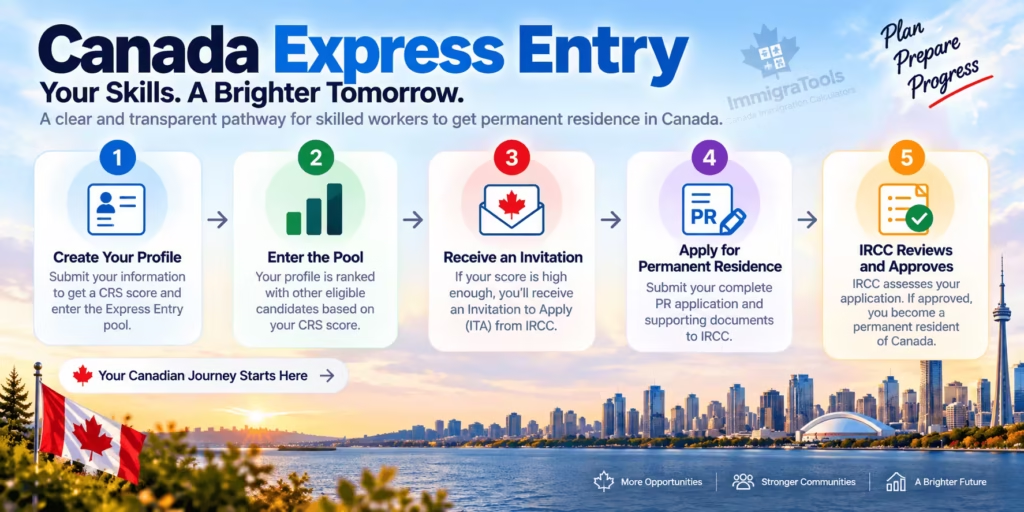
What Express Entry actually is
IRCC launched Express Entry in January 2015 to replace a first-come, first-served system that had built up a multi-year backlog. Instead of processing applications in the order they arrived, IRCC now keeps a pool of candidates, ranks them, and invites the strongest. Submitting a profile is free, and it commits you to nothing.
The distinction that trips people up is this: sitting in the pool is not an application. Nothing is being assessed and no officer is looking at your file. Only when you receive an Invitation to Apply does a real application begin, and from that moment you have 60 days to file it. IRCC works to a six-month processing standard for most complete Express Entry applications after that.
The three programs Express Entry manages
Express Entry does not have its own eligibility rules. It manages three federal programs, and you have to qualify for at least one of them before your profile can go into the pool at all.
- Federal Skilled Worker Program: for skilled work experience gained anywhere in the world. It needs at least one year of continuous skilled work in the last ten years, CLB 7 in every language ability, and a pass on a separate 67-point selection grid that scores age, education, experience and adaptability. Foreign qualifications need an Educational Credential Assessment.
- Canadian Experience Class: for people who have already worked in Canada. It needs at least one year of skilled Canadian work experience in the last three years, with CLB 7 for TEER 0 and 1 occupations or CLB 5 for TEER 2 and 3. There is no education requirement and no proof-of-funds requirement.
- Federal Skilled Trades Program: for people in a skilled trade. It needs two years of experience in the trade within the last five years, plus either a valid job offer or a certificate of qualification issued by a province or territory. Language minimums are CLB 5 for speaking and listening, and CLB 4 for reading and writing, the lowest of the three programs.
If you are not sure which of the three fits you, our Express Entry eligibility checker walks the gates for all three in a couple of minutes.
How the pool ranks you: the CRS
The Comprehensive Ranking System scores every profile out of 1,200 points, in three blocks. Core human capital, covering age, education, official language ability and Canadian work experience, is worth up to 500 points on your own, or 460 plus 40 for your spouse’s factors if you apply with a partner. Skill transferability, which rewards combinations such as strong language plus foreign experience, adds up to 100. Additional points are worth up to 600 on their own: a provincial nomination is 600, strong French is 25 or 50, a Canadian credential is 15 or 30, and a sibling in Canada is 15. Job-offer points were removed on 25 March 2025 and no longer count.
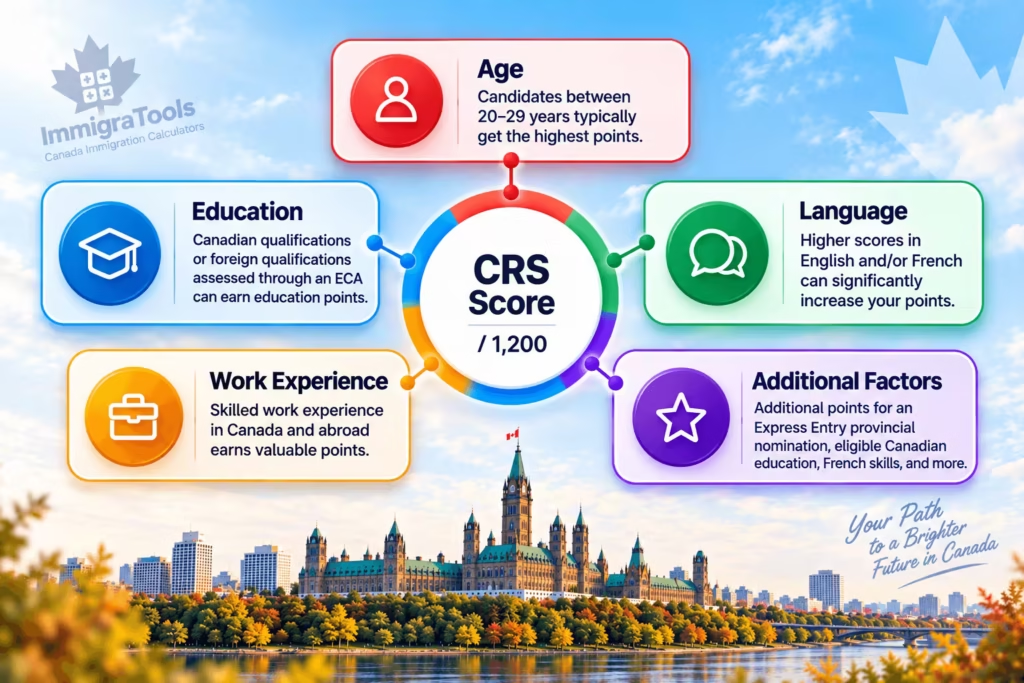
In practice two things move the needle more than anything else. The first is language: the jump from CLB 8 to CLB 9 is the single largest gain most candidates can still make, and it feeds the transferability block as well as the core one. The second is a provincial nomination, which is worth 600 points and usually puts you well above a PNP-round cut-off. It does not guarantee an invitation in the next round IRCC holds. Everything else is fine tuning. You can see exactly where your own points sit with our CRS score calculator.
The three kinds of round IRCC holds
Not every round invites the same people, and the cut-off means something different in each one.
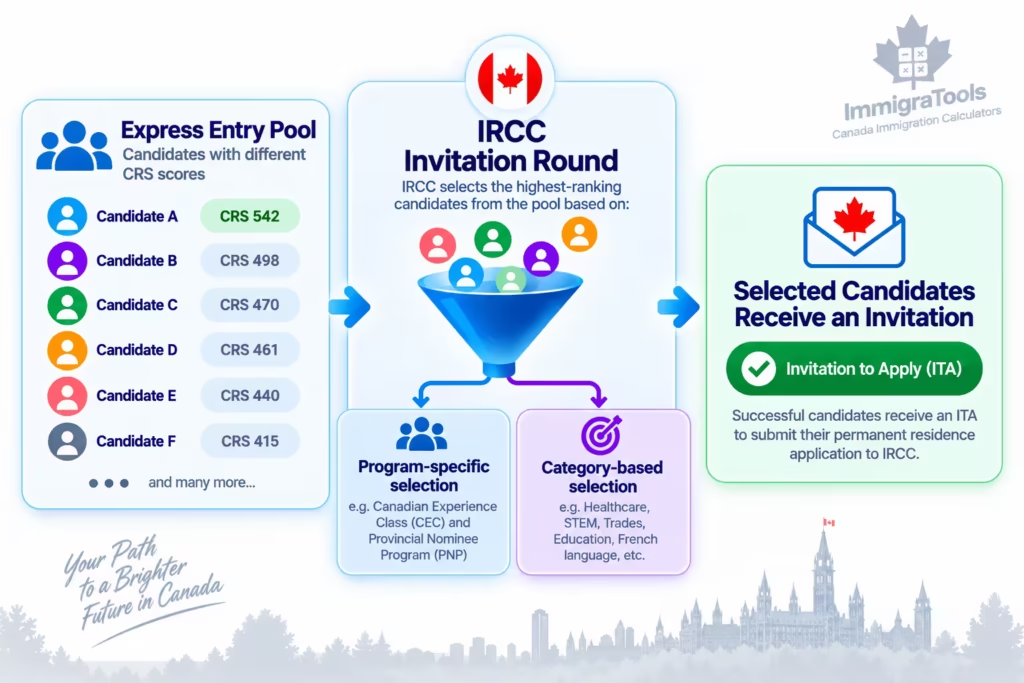
- General, or all-program rounds rank the entire pool together and invite the highest scores, whichever program they qualify under. These are the rounds people mean when they talk about “the CRS cut-off”, and they are the hardest to be picked in.
- Program-specific rounds narrow to one program first. Canadian Experience Class rounds and Provincial Nominee Program rounds are the two IRCC uses most.
- Category-based rounds narrow to candidates with a particular occupation, or with strong French, and only then rank that smaller group. Because the field is cut before anyone is scored, the cut-off in a category round is usually well below an all-program round held around the same time.
This is why a single “what score do I need” answer does not exist. The number you need depends entirely on which door you are being considered through.
Recent Express Entry rounds
Every round below comes straight from IRCC’s published rounds of invitations. The table is copied from that feed on a schedule; if a sync is delayed, the sources block at the bottom of this page will say so. The most recent round on record is #444, held on Sep 16, 2026, which invited 250 candidates at a CRS cut-off of 389.
| Draw # | Date | Category | CRS Cut-off | Invitations |
|---|---|---|---|---|
| Draw #444 | Sep 16, 2026 | Senior managers with Canadian Work Experience, 2026-Version 1 | 389 | 250 |
| Draw #443 | Sep 15, 2026 | Canadian Experience Class | 519 | 2,000 |
| Draw #442 | Sep 14, 2026 | Provincial Nominee Program | 734 | 576 |
| Draw #441 | Sep 4, 2026 | Healthcare and Social Services Occupations, 2026-Version 3 | 475 | 3,500 |
| Draw #440 | Sep 3, 2026 | Physicians with Canadian Work Experience, 2026-Version 1 | 198 | 229 |
| Draw #439 | Sep 1, 2026 | Canadian Experience Class | 521 | 2,000 |
| Draw #438 | Aug 31, 2026 | Provincial Nominee Program | 697 | 562 |
| Draw #437 | Aug 19, 2026 | French-Language proficiency 2026-Version 2 | 382 | 5,000 |
| Draw #436 | Aug 18, 2026 | Canadian Experience Class | 523 | 1,000 |
| Draw #435 | Aug 17, 2026 | Provincial Nominee Program | 760 | 442 |
The categories IRCC is using in 2026
The Minister sets the category list each year, after consulting provinces, employers and unions, and publishes it before the rounds start. A category never changes your CRS score. What it changes is who you are ranked against, and that is usually worth more than a handful of points. Categories are not exclusive either: if your occupation appears on two lists, or you qualify on both an occupation and French, you are eligible for every round you meet the criteria for.
- French-language proficiency Judged on a TEF or TCF result of NCLC 7 or higher across all four abilities: no particular job required.
- Healthcare and social services occupations The widest occupation list of any category, from nurses and physiotherapists to social workers and dentists.
- Science, Technology, Engineering and Math (STEM) occupations A short, engineering-heavy list: civil, mechanical, electrical and related engineers, plus architecture and science managers, cybersecurity specialists, and insurance agents and brokers. Software developers and data scientists are not on it.
- Trade occupations Carpenters, electricians, plumbers, welders, heavy-equipment mechanics and related trades.
- Education occupations Added for 2025 and kept for 2026: teachers, early childhood educators and instructors.
- Transport occupations A narrower list than 2023: aviation plus automotive and truck/bus mechanics. Truck drivers and rail roles are not on it.
- Physicians with Canadian work experience One of three categories built around experience gained inside Canada rather than abroad.
- Senior managers with Canadian work experience NOC Major Group 00 roles only: executives who set organisational direction, with the qualifying year worked in Canada.
- Researchers with Canadian work experience University professors, lecturers and post-secondary research assistants, with Canadian experience. No dedicated round has been held yet.
- Skilled military recruits Foreign military members with a Canadian Forces Recruiting Group job offer, 10 years of service, and a two-year credential.
Every Express Entry draw type we track
Each page below carries the complete history for that kind of round: every cut-off, every date, how many invitations went out, and who qualifies. All of it is built from the same live IRCC data as the table above.
- HC Healthcare-category draws
- FR French-language draws
- CEC Canadian Experience Class draws
- PNP PNP draws
- ST STEM-category draws
- TR Trades-category draws
- EE General (all-program) draws
- MD Physician-category draws
- SM Senior-manager draws
- RS Researcher-category draws
- CAF Skilled-military-recruit draws
- ED Education-category draws
- TP Transport-category draws
- AG Agriculture and agri-food draws
- FST Federal Skilled Trades draws
- ALL Full draw history (every round)
How to enter Express Entry, step by step
The order matters more than most guides admit. Language results take weeks to arrive, and every program needs them before you can submit a profile. An educational credential assessment is only required for some candidates, so start that if you need one, not because every profile does.
-
Check that one of the three programs will take you
Express Entry is a queue, not a program. Before anything else you need to qualify for the Federal Skilled Worker Program, the Canadian Experience Class or the Federal Skilled Trades Program, and each has its own floor for work experience and language.
-
Sit an approved language test
IELTS General Training, CELPIP-General or PTE Core for English; TEF Canada or TCF Canada for French. Results are valid for two years and every CRS calculation you do before you have them is guesswork.
-
Get an education assessment only if you need one
An Educational Credential Assessment is required if you apply through the Federal Skilled Worker Program with a foreign credential. Canadian Experience Class and Federal Skilled Trades have no education requirement, so you can enter the pool without one. You still need an ECA if you want CRS points for education completed outside Canada. Canadian credentials do not need one.
-
Find the right NOC code for your work
Your occupation decides which programs you qualify for and which categories you can be picked from. Match on the duties listed in the NOC, not on your job title.
-
Submit your profile and join the pool
A profile is free and stays in the pool for 12 months. You are ranked against everyone else in it by your CRS score, and you can update your profile at any time as new scores or experience come in.
-
Wait for a round you qualify for, and keep improving
You may be picked in a general round, a program round or a category round. A provincial nomination adds 600 CRS points, which is usually enough to clear a PNP round. It does not guarantee an invitation in the next round IRCC holds.
-
Apply within 60 days of an invitation
An ITA starts a 60-day clock for the full permanent residence application: police certificates, medicals, proof of funds and reference letters. IRCC aims to process most complete applications within six months.
Not sure which occupation code describes your work? Our NOC finder matches your duties against the 2021 codes IRCC uses.