

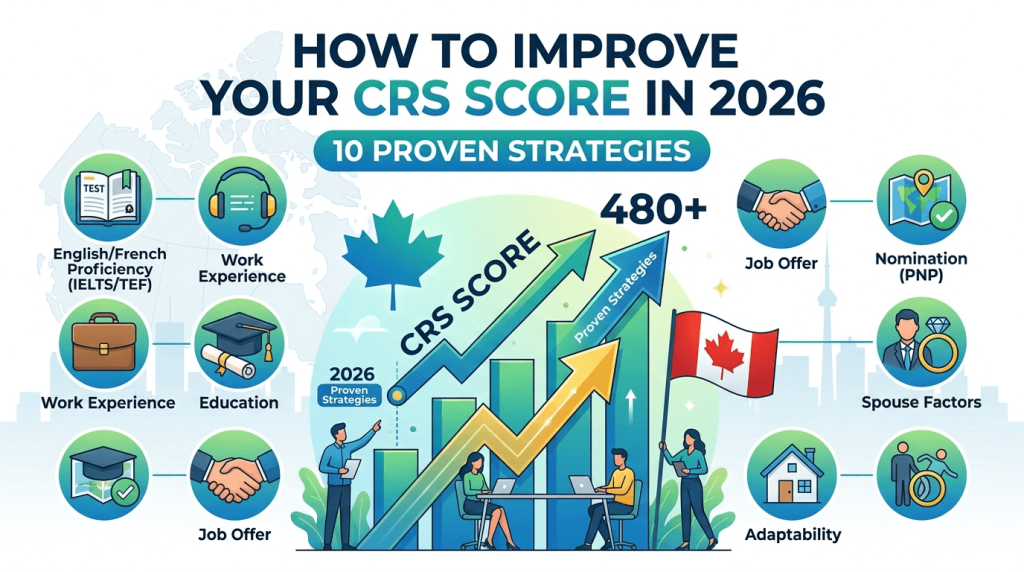
How to improve CRS score is one of the most common questions asked by Express Entry candidates in 2026. A higher Comprehensive Ranking System (CRS) score can significantly increase your chances of receiving an Invitation to Apply (ITA) for Canadian permanent residence. This guide explains the most effective ways to improve your CRS score, including language tests, education, Provincial Nominee Programs (PNPs), work experience, and other proven strategies.
Your Comprehensive Ranking System (CRS) score is not a pass/fail exam. It is a ranking. Even a gain of 15–30 points can move you ahead of tens of thousands of other candidates. The good news: unlike age (which ticks down over time), several CRS factors are genuinely in your control — especially language, education planning, Canadian experience, and provincial nominations.
This guide walks through 10 proven strategies to improve your CRS in 2026, in plain language, with realistic point ranges and a suggested order of attack. Use it alongside our free CRS Score Calculator so you can test “what if” scenarios before you spend money on tests, courses, or applications.
Important: This article is educational, not legal advice. CRS rules, draw types, and provincial streams change. Always confirm your plan against current IRCC and provincial program instructions, or consult a Regulated Canadian Immigration Consultant (RCIC).
Start here: know your score and your gap
Before you chase random tips from forums, get a clear baseline:
- Run the CRS Score Calculator with your real age, education, language, and work history.
- Check the latest Express Entry draw cut-offs for the round type that applies to you (all-program, French, healthcare, STEM, trades, etc.).
- Subtract your score from the cut-off you are targeting. That number is your gap.
Example: if general draws are around 485 and you are at 452, you need roughly 33 points — not 200. That changes your strategy completely. A language retake might be enough; a provincial nomination (+600) would be powerful but takes longer.
Not sure you are even eligible for Express Entry yet? Start with the Express Entry Eligibility Checker (FSW, CEC, FST gates) before you optimize CRS.
How CRS points really work (the 60-second version)
CRS is out of 1,200 points. For most candidates without a provincial nomination, the core profile tops out around 600 from human capital and skill transferability. The other 600 exists largely for Provincial Nominee Program (PNP) nominations linked to Express Entry.
The highest-impact levers for most people:
- Language — often the fastest points gain per month of study
- Canadian work experience — builds slowly but compounds with transferability
- Education — Canadian credentials can add up to 30 points
- PNP nomination — +600 when accepted into your Express Entry profile
- French proficiency — direct CRS bonus + access to lower cut-off draws
Confirm your occupation with the NOC Finder early. A wrong NOC code can disqualify you from category-based draws even if your CRS is strong.
1. Retake your language test (often the best ROI)
Language is the most underrated CRS upgrade. Many candidates lose points not because their English is “bad,” but because one skill (usually writing or reading) drags their profile down — and CRS uses your scores across four skills, plus transferability combinations with education and foreign work.
What a retake can be worth
Moving your lowest CLB from 8 to 9 across skills can add meaningful core points and unlock skill transferability bands. Reaching CLB 10 in all skills is a different league entirely. Use our CLB Converter to see exactly where your IELTS or CELPIP bands sit today, and what your next target should be.
Practical study plan
- Identify the weakest skill first. Retaking everything without focus often repeats the same band.
- Book your test early — popular centres fill up months ahead in some cities.
- Remember expiry dates. IRCC language results are valid for two years from the test date. An expired test cannot stay in your profile.
- Consider CELPIP vs IELTS. Some candidates score higher on one format; choose the test that fits your strengths.
If you are planning a retake, model the new score in the CRS calculator before you pay for another sitting. A 0.5 IELTS band improvement in one skill might be worth 10+ CRS points — or fewer than you expect, depending on your spouse status and education combo.
2. Pursue a valid Canadian job offer (when it is real)
A genuine job offer can add 50 or 200 CRS points, depending on the NOC TEER level of the role. TEER 0/1 managerial and professional roles can qualify for the higher band; many other skilled roles add 50.
But be careful with internet advice that treats job offers as easy points. IRCC requires offers to meet strict rules — often including a supporting LMIA or an LMIA-exempt category, correct employer details, and a full-time, non-seasonal position. A casual “offer letter” without the right backing will not add CRS points.
Where job offers help most
- Candidates stuck in the 460–480 range who already have Canadian work ties
- Workers already in Canada on permits with employers willing to support PR
- Trades and specialized roles where employers routinely use immigration pathways
Pair this strategy with an accurate NOC code that matches your day-to-day duties — not just your job title on paper.
3. Apply for a provincial nomination (+600 points)
If your CRS is far below general draw trends, a provincial nomination linked to Express Entry is the single largest CRS boost available: +600 points. After you accept a nomination in your Express Entry account, your effective ranking score jumps overnight — for example, from 420 to 1,020.
That does not mean PNPs are “easy.” Provinces run their own streams, EOI systems, and invitation rounds. Ontario, BC, Alberta, Saskatchewan, Manitoba, and Atlantic programs all work differently.
How to explore PNPs intelligently
- Compare your profile across regions with the PNP Score Calculator (pathway fit, not just CRS).
- Drill into province-specific scoring: OINP Points Calculator or BC PNP Calculator.
- Watch for Express Entry–linked streams vs base streams — only the linked nomination adds 600 CRS points.
PNP is often the right strategy when language retakes and Canadian experience alone will not close a 80+ point gap before your profile ages down.
4. Earn or claim Canadian education points
A post-secondary credential completed in Canada can add up to 30 CRS points, depending on program length and level. For candidates already studying in Canada, finishing a diploma or degree is both an immigration strategy and a career strategy.
Even if you already hold a foreign degree, a one- or two-year Canadian credential can unlock points you do not have today — plus stronger local hiring outcomes. Spouses studying in Canada can also shift the household’s overall competitiveness if you apply as a couple.
Before enrolling, check how your current CRS breaks down in the calculator. Education points are helpful, but they may not move the needle as much as language or a nomination if you are already at a master’s or doctorate level.
5. Build Canadian skilled work experience
Canadian work experience affects CRS in two ways: direct core points (up to 80 for five years, depending on profile) and skill transferability when combined with language and education.
If you are working in Canada on a closed or employer-specific permit, each additional year of skilled NOC TEER 0–3 experience can steadily raise your score — even without changing jobs. CEC-eligible candidates should also track the three-year window for recent Canadian experience used in program eligibility.
Who benefits most
- PGWP holders in skilled roles
- International graduates transitioning to employer-supported permits
- Spousal open work permit holders in professional jobs
Make sure your role matches a skilled NOC and that your reference letters will support that code if IRCC requests proof.
6. Add French — even if you are not bilingual yet
French is one of the few CRS strategies that can both raise your score and change which draws you qualify for. Strong French results can produce:
- Additional CRS points for second official language ability
- Access to French-language priority draws, which have sometimes invited candidates with CRS scores well below general cut-offs
- Provincial advantages in Ontario and other programs that reward bilingual candidates
You do not need perfect French. Many candidates take TEF Canada or TCF Canada after structured study and convert results using the CLB Converter. Model French scenarios in the CRS calculator to see whether the study investment beats another English retake for your profile.
7. Use your spouse’s profile strategically
If your spouse or common-law partner will accompany you, their education, language, and Canadian work experience can add CRS points under the spouse factors. Couples often optimize the wrong profile — the higher potential candidate should usually be the principal applicant.
Practical couple tactics
- Compare CRS with each person as principal applicant (age and work history differ).
- Invest in the accompanying partner’s language test if their CLB lifts spouse factors.
- Align Canadian work and study plans so at least one profile keeps strengthening while the other works.
If only one partner is strong in French, that may decide who should lead the Express Entry profile.
8. Claim a sibling in Canada (+15 points)
If you (or your spouse, depending on profile structure) have a brother or sister who is a Canadian citizen or permanent resident living in Canada, you may qualify for 15 additional CRS points. It sounds small compared with a PNP, but 15 points can be the difference between missing and receiving an ITA when cut-offs are tight.
Documentation matters. IRCC will expect proof of the sibling relationship and eligible status in Canada. If this applies to you, do not leave it unclaimed — it is one of the simplest points on the grid.
9. Target category-based Express Entry draws
Since 2023, IRCC has run category-based selection rounds for candidates in specific occupations (healthcare, STEM, trades, transport, agriculture, and others) and for strong French speakers. These draws sometimes have lower CRS cut-offs than general all-program rounds.
Category eligibility depends heavily on your NOC code and work history matching official occupational descriptions — not just your job title. Use the NOC Finder, then read the lead statement and main duties on the official NOC site before you assume you qualify.
Track which categories IRCC actually invites over time on our Draw History page. Policy priorities shift; last year’s hot category may not be this year’s.
10. Keep your profile accurate, active, and patient
CRS improvement is not only about gaining points — it is also about not losing them.
- Update expired language tests before they fall off your profile.
- Refresh work history when you gain another year of skilled experience.
- Fix errors early — wrong NOC, marital status, or education level can cause refusals later, not just lower scores.
- Watch draw types — you might qualify for a targeted round even when general draws feel out of reach.
Many successful candidates receive ITAs after 12–24 months of incremental improvements. Express Entry rewards persistence when it is paired with a plan.
Which strategy should you prioritize?
Use this quick framework based on your gap to a realistic target cut-off (check recent draw results first):
| Your situation | Start with | Then consider |
|---|---|---|
| Within ~30 points of general cut-offs | Language retake + CLB mapping | French bonus, sibling points, job offer if genuine |
| 30–80 points below | Language + Canadian experience plan | Category-based draw eligibility, PNP research |
| 80+ points below (no nomination) | PNP pathway review | Canadian study or long-term experience strategy |
| Strong French potential | TEF/TCF study + French draws | Parallel English optimization |
| Already in Canada working | Experience accumulation + CEC path | Employer-supported PNP streams |
Common mistakes that waste time and money
- Retaking IELTS without a weakest-skill plan — you repeat the same band.
- Assuming any job offer adds 200 points — TEER and LMIA rules matter.
- Ignoring NOC duty match — category draws and PNP streams depend on it.
- Letting tests expire — your CRS can drop when valid results disappear.
- Waiting for a perfect score instead of entering the pool when eligible — you cannot receive an ITA if you are not ranked.
What is a competitive CRS score in 2026?
There is no single “pass mark.” General all-program draws in recent cycles have often landed in the high 470s to low 500s, but cut-offs vary every round. Category-based and French-language draws have invited candidates well below those levels when policy priorities align.
Think in percentiles, not absolutes: a score of 470 might be weak in a general draw but excellent in a targeted healthcare or French round. Calculate your profile, compare recent draws, and plan for the type of invitation you can realistically target in the next 6–12 months.
Your next steps (free tools on this site)
- Express Entry Eligibility Checker — confirm FSW / CEC / FST gates
- NOC Finder — verify occupation code and TEER
- CLB Converter — map IELTS, CELPIP, TEF, or TCF to CLB
- CRS Score Calculator — model improvements before you spend on tests or applications
- Express Entry Draw History — track real cut-offs
- PNP Score Calculator — compare provincial pathways if CRS alone is not enough
Improving your CRS is rarely one big fix. It is a sequence of smart moves — language, experience, credentials, and sometimes a provincial nomination — chosen with your real gap and timeline in mind. Start with the calculator, pick one strategy from this list, and build momentum from there.