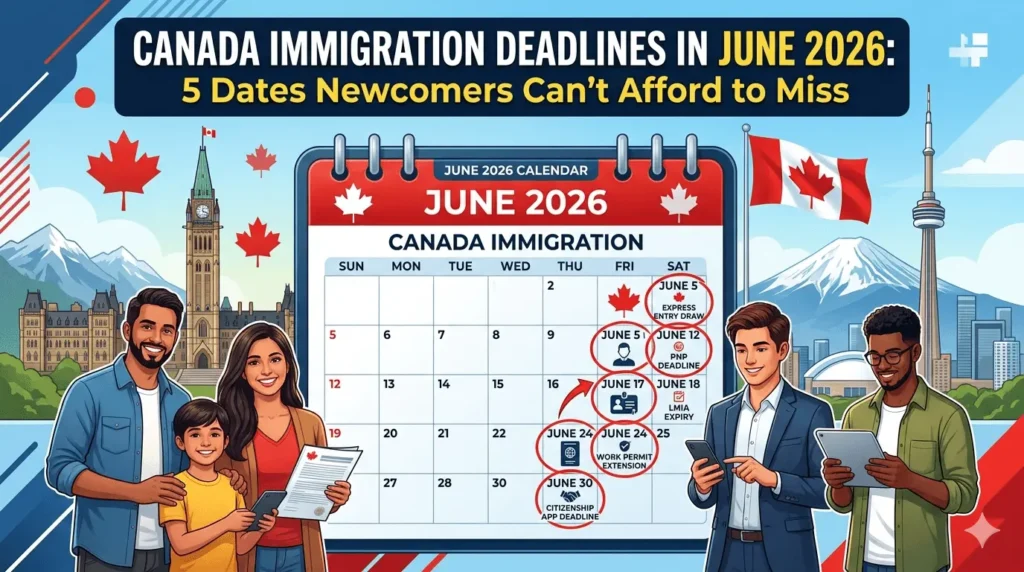
Canada immigration deadlines in June 2026 are piling up quietly — and none of them can be extended once they pass. If you’re a work permit holder studying in Canada, planning to apply for permanent residence, waiting on a provincial nomination, or sponsoring family in Quebec, at least one date this month probably applies to you.
Here’s a simple guide to every confirmed change in June 2026, what it means for you, and what to do before each window closes.
June 27: The Study-Without-a-Permit Policy Expires
This is the deadline with the most immediate impact on people already in Canada. Since June 2023, a temporary IRCC public policy has allowed certain work permit holders to study full time or part time without a separate study permit. That flexibility ends on June 27, 2026.
The policy applied to workers who held a valid work permit applied for on or before June 7, 2023 (or who had a renewal in by that date). It removed the old rule limiting work permit holders to programs of six months or less.
What to do if you’re studying under this policy
If your program continues past June 27, you need a valid study permit to keep studying legally. Study permit processing times vary widely by country and application type, so apply as early as possible — ideally immediately.
Two traps to avoid:
- Studies under this policy do not count toward a Post-Graduation Work Permit (PGWP). PGWP eligibility requires holding a valid study permit throughout your program.
- Work experience gained while studying full time under this policy does not count toward the Canadian Experience Class.
If either of those affects your long-term PR plan, talk to a licensed immigration professional before deciding your next step.
June 14: Your Last Chance to Shape Canada’s 2027–2029 Immigration Targets
IRCC’s public consultation on the 2027–2029 Immigration Levels Plan closes on June 14, 2026 — and IRCC has confirmed late survey submissions won’t be accepted.
This matters more than it sounds. The current plan sets permanent resident admissions at 380,000 per year (range: 350,000–420,000) and includes targets for temporary residents and Francophone immigration. The feedback gathered now will influence how many newcomers Canada admits — and which programs get priority — for the next three years. If you’re an applicant, employer, or settlement organization, the online survey is the most direct channel you’ll get.
Ontario’s OINP Enters a New Era
June is the first full month under Ontario’s overhauled regulatory framework, which took effect May 30, 2026. The province can now create, remove, or redesign Ontario Immigrant Nominee Program (OINP) streams without a lengthy regulatory amendment process each time.
Nine legacy applicant categories were revoked on May 30. If you applied before that date, your application should be assessed under the old rules — but candidates sitting in the Expression of Interest pool under revoked streams face real uncertainty.
The flip side: Ontario holds Canada’s largest 2026 PNP allocation at 14,119 nominations, and brand-new streams targeting specific occupations and regions could now launch with little notice. If you’re in the OINP pool, check the program’s updates page weekly this month.
June 15: BC PNP Opens a Targeted Health Support Pathway
British Columbia’s new Temporary Rural / Remote Health Support initiative opens for registration on June 15, 2026 and runs until August 31. It’s narrow by design: only cleaning and security workers already employed by a health authority in rural or remote B.C. communities qualify. Urban workers and private-sector employees are not eligible.
It sits under B.C.’s new “Care, Build, Innovate” framework, which now organizes all Skills Immigration nominations around healthcare and education, construction trades, and high-impact tech and research talent. If you think you qualify for the health support initiative, review the updated Skills Immigration Program Guide and register early — one-time programs like this can fill quickly.
June 25: Quebec Family Sponsorship Reception Period Ends
Quebec’s two-year reception window for family sponsorship undertakings closes on June 25, 2026. The province capped intake at 13,000 applications, and most categories — spouses, partners, dependent children 18+, parents, and grandparents — hit their limits back in mid-2025.
Important: the window closing does not mean sponsorships automatically reopen on June 26. Quebec’s immigration ministry (MIFI) has only committed to announcing its next decision by June 25. The smart move for hopeful sponsors is to prepare all documents now so you can file the moment a new window opens. (Sponsors outside Quebec are unaffected by these caps.)
Quebec also plans to issue final decisions by June 30 on certain legacy Regular Skilled Worker Program files where applicants responded to a notice of intention to refuse — so watch your MIFI correspondence closely.
A Quick Word for PGWP Applicants
The language-test requirement applies to most PGWP applications submitted on or after November 1, 2024. IRCC’s online checklist may label language results as “optional” — don’t be fooled. If the requirement applies to your program, missing results can sink your application.
Key Takeaways
- June 14: 2027–2029 immigration levels consultation closes — no late submissions.
- June 15: BC PNP rural/remote health support registration opens (cleaning and security staff at health authorities only).
- June 25: Quebec family sponsorship reception period ends; next steps to be announced.
- June 27: Study-without-a-permit policy expires — apply for a study permit now if your program continues.
- June 30: Quebec issues decisions on legacy skilled worker files.
- Express Entry reform and new consultant regulations are coming, but they are not in force in June — don’t plan around unconfirmed rules.
Take Action Before the Window Closes
Immigration success in 2026 is increasingly about timing. None of this month’s deadlines can be extended, and several affect your legal status or your family’s path to Canada. Review each date against your situation today, gather your documents, and if a deadline applies to you, act this week rather than next. Your Canadian journey is worth protecting — check your eligibility and get your applications in before the clock runs out.