

Select text in this article, then choose Listen to start reading from there. Audio uses your browser’s text-to-speech voice.
Saved articles stay in this browser on this device.
Saved articles on this device
Clearing browser data removes this list.
Short answer: yes, you may be able to study on a work permit in Canada without applying for a separate study permit. The rule is narrow: your permit must still be valid, the program must be six months or less, and your plan can affect the Canadian work experience you rely on for Express Entry.
That last part matters. A course can look like a simple way to add a licence, credential or new skill. But if you move into full-time study, the work you do during that period may not count for the Canadian Experience Class or Canadian work-experience points in Express Entry. Check the consequences before you pay tuition.
IRCC introduced this temporary public policy on September 4, 2026. It is scheduled to run until December 31, 2027, although IRCC can end it earlier.
Can you study on a work permit in Canada?
Under IRCC’s current temporary policy, you may study without a study permit if both of these are true:
- You hold a valid Canadian work permit.
- Your course or program is six months or less.
You can study for up to six months or until your work permit expires, whichever comes first. A six-month course does not give you extra time in Canada. If your permit ends in four months, your permission under this policy ends then too.
Example: Amira has an open work permit valid until February 2027. In October 2026, she enrols in a 16-week licensing course. The course is under six months and finishes before her permit expires, so it fits the basic timing rule. If the same course ran for eight months, she would need to look at a study permit instead.
What changed in September 2026?
Canada has long had a general exemption for short programs. Normally, a course of six months or less must also be completed within the period a person was initially authorized to stay in Canada. The new policy gives qualifying work-permit holders more flexibility for short-term training while their work permits remain valid.
IRCC says the policy is intended to help workers upgrade skills, obtain credentials or professional licensing, and move into higher-skilled work. It is not a new route to enter Canada, and it does not turn every long program into a permit-free course.
Use this three-question check before you enrol
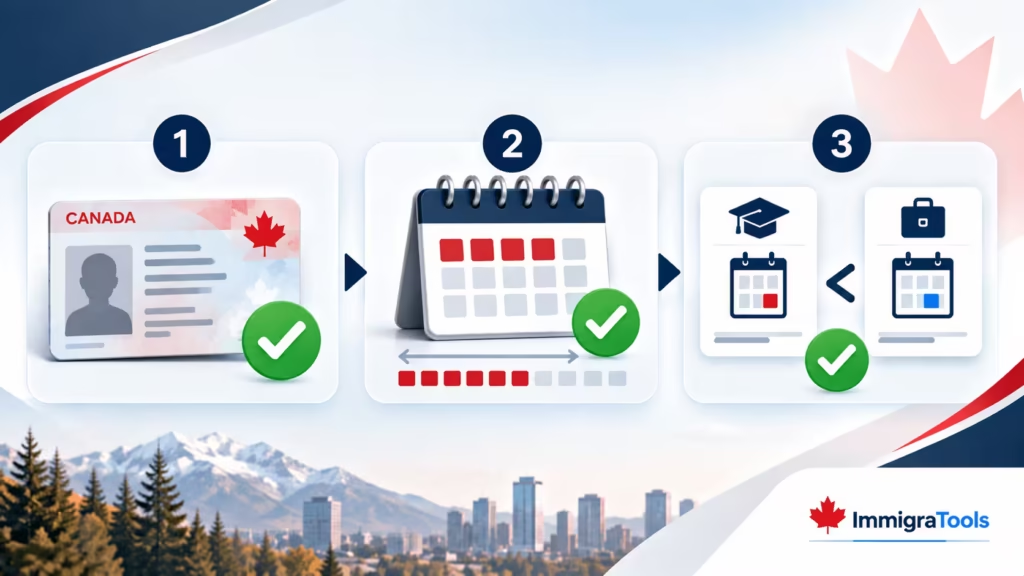
- Is your work permit valid on the day your course starts? A visitor record, a job offer or an application receipt is not the same as holding a valid work permit.
- Is the program six months or less? Look at the official start and end dates, not only the number of classes each week.
- Will it finish before your work permit expires? The earlier date controls.
If the answer to any question is no, pause before enrolling and check whether you need a study permit. If you plan to continue into another program after the short course, a study permit is usually the safer route from the beginning.
What the policy does and does not change
- Work-permit study conditions: IRCC says that study-related conditions on your work permit do not apply under this temporary measure.
- Your employment contract: If studying means fewer work hours, you still need an agreement with your employer. Immigration permission does not rewrite your employment contract.
- Permit expiry: You must stop relying on this policy once the permit expires, even if the school program continues.
- Longer programs: A program longer than six months needs a study permit.
Full-time study can affect your Express Entry plan
This is the part many workers miss. IRCC’s detailed instructions say that if you study full-time under the temporary policy, work experience gained during those studies does not count toward Canadian Experience Class eligibility or Canadian work-experience points in the Comprehensive Ranking System.
For someone building one year of skilled Canadian experience, that can change the timeline. Do not add those months to your CEC total simply because you continued working under a valid work permit. Before changing your schedule, use the Express Entry Eligibility Checker and estimate the score effect with the CRS Score Calculator.
Important: IRCC’s September 2026 announcement and its detailed worker instructions are not perfectly aligned on full-time study. The detailed page explains the Express Entry consequence of full-time study under the policy, while the announcement says full-time studies still need a study permit. If you intend to study full-time, get advice specific to your permit and program before you enrol.
What if your course includes a co-op, practicum or internship?
A classroom course and a work placement are not always treated the same way. If your short program includes a co-op placement, you may need a new employer-specific work permit before the placement begins if the co-op employer or occupation differs from the employer or occupation named on your current permit.
| Your situation | What to check |
|---|---|
| Open work permit | IRCC says you do not need a new work permit for the co-op placement under this rule. |
| Employer-specific permit, same employer and occupation | Confirm the placement fits the permit conditions and your employer agreement. |
| Employer-specific permit, different employer or occupation | You may need a second employer-specific work permit before starting the placement. |
Do not start a placement first and sort out the permit later. Ask the school for written details of the placement: employer, role, dates and whether it is mandatory.
Can workers in Quebec use this policy?
Yes. IRCC says qualifying workers can study in Quebec without a study permit under this policy. It also says a qualifying worker does not need a Québec Acceptance Certificate (CAQ) for that short study under the temporary measure. Check the program’s admissions requirements before registering.
When should you apply for a study permit instead?
A study permit is the better route when your plan does not fit the short-course exception. Apply for one if:
- your program lasts longer than six months;
- your work permit will expire before you finish the course;
- you plan to continue into another program after the short course;
- you need the study-permit framework for a longer full-time program; or
- you want certainty before making a major tuition commitment.
A study permit and a work permit can exist at the same time, but you must qualify for both and explain realistically how you will meet the conditions of each.
Common mistakes to avoid
- Counting from the wrong date. Six months is about the program’s official duration, not how little time you expect to spend on homework.
- Ignoring the work-permit end date. The policy does not extend your permit or your status in Canada.
- Assuming co-op is automatically covered. A placement can require different work authorization.
- Counting full-time-study work toward CEC. That work may not qualify for CEC eligibility or CRS points.
- Relying on outdated advice. The earlier temporary measure ended in June 2026. This is a new policy with a six-month limit.
What to do before you pay tuition
Get the school to confirm the program’s exact start and end dates, whether it includes a placement, and whether the institution needs to see your work permit. Then compare those dates with your permit expiry and your Express Entry plan. If your course would interrupt the Canadian experience you need for PR, calculate that cost before you commit.
For current invitation scores, see the latest Express Entry draw. Immigration rules apply differently to individual facts, so use official IRCC guidance and get regulated advice when your permit, co-op placement or permanent-residence strategy is complicated.