


Select text in this article, then choose Listen to start reading from there. Audio uses your browser’s text-to-speech voice.
Saved articles stay in this browser on this device.
Saved articles on this device
Clearing browser data removes this list.
You have an Express Entry profile and a CRS score. You may even qualify for a category such as trades or healthcare. So why has no invitation arrived? Because entering the pool is only the first gate. In every draw, IRCC invites the highest-ranked candidates who qualify for that particular round.
The short answer: Your Express Entry chances depend on three separate questions: Are you eligible for a federal program? Do you meet any category requirements? Is your CRS score high enough for a round you can actually enter? A past cut-off can help you plan, but it cannot predict your next invitation.
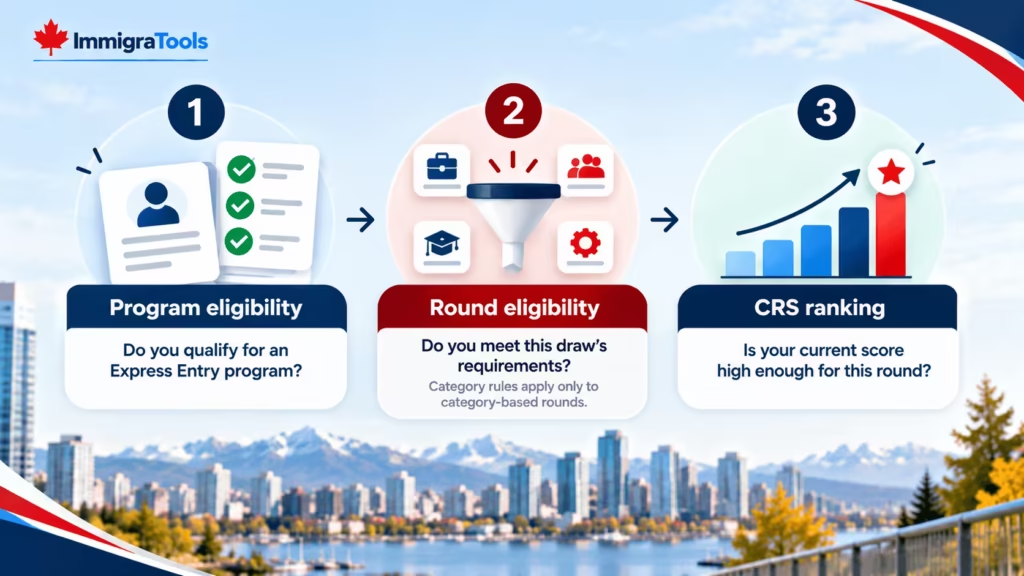
First, check which gate you have passed
Program eligibility gets you into the pool. You must qualify for at least one of the Canadian Experience Class, Federal Skilled Worker Program or Federal Skilled Trades Program. Our Express Entry eligibility checker can help you review the requirements, but IRCC makes the official decision.
A category is another filter, not a separate immigration program. For example, someone may qualify for the trades occupation category while being eligible for the pool through CEC or FSW, rather than the Federal Skilled Trades Program. IRCC then ranks the category-eligible candidates by CRS score. Check each category’s current rules separately: for example, the French-language category requires NCLC 7 or higher in speaking, listening, reading and writing. See IRCC’s category-based selection guide.
Your CRS score ranks your profile. IRCC assigns points for factors such as age, education, language ability and work experience. Being in the pool does not mean your score will clear a draw. Check your current score in your IRCC account and use our CRS calculator to test possible changes.
Why an eligible candidate may still receive no invitation
1. You are comparing your score with the wrong draw
A CRS 480 cut-off in a trades round does not mean every candidate at 480 was invited. Only candidates meeting that round’s trades requirements competed in it. A CEC round is limited to CEC-eligible candidates. A PNP round requires a qualifying provincial nomination. Use the full draw history to filter for rounds you could actually enter before comparing scores.
2. You meet a category’s occupation label but not its detailed rule
Job titles are unreliable shortcuts. Occupational categories use specific NOC codes and work-experience requirements. For the 2026 trades category, IRCC requires at least 12 months of qualifying experience in one listed occupation within the previous three years; the experience need not be continuous or Canadian. Check the current occupation list and match your actual duties using our NOC Finder, then verify them against IRCC’s category criteria.
3. You treat an old cut-off as a promise
IRCC chooses the round type and invitation count, and candidates’ scores determine the cut-off. The next draw may target a different group. Even another round in the same category can have a different cut-off. Our latest-draw page tells you what happened; it does not forecast what IRCC will do next.
4. Your score assumes points you have not yet earned
A planned language retest, future work anniversary or possible nomination does not improve your current rank. Compare draws with the score that actually appears in your IRCC profile today. You can model a future score separately, but keep the two numbers distinct. IRCC also removed CRS points for job offers in March 2025, so an older calculation may mislead you. Check IRCC’s current CRS guidance.
5. Your profile no longer reflects your situation
A new language result, changed job, marriage or other life change can affect your information. IRCC says to keep your profile up to date. Language results must still be valid, and you need evidence for the points and category experience you claim. Review the IRCC profile instructions before assuming the score you calculated elsewhere is the score IRCC is using.
Three profiles show how the checks work
Amir: eligible for FSW, but outside a trades round. Amir has a CRS score of 490 and works in a skilled occupation. A trades draw closes at 476. His score is higher, but his occupation is not on the trades category list. That draw tells him nothing about his invitation prospects. He should compare his score with rounds he is eligible for and check whether another category applies.
Priya: trades-category eligible, but below that round’s cut-off. Priya qualifies for an Express Entry program and has the required recent experience in one listed trade. Her CRS is 470. If an eligible trades round closes at 476, she is not invited in that round. Being in the right category is essential, but it is not enough on its own. She can review realistic ways to raise her CRS and watch subsequent trades draw results.
Daniel: eligible for CEC, but looking at a future score. Daniel has CRS 505 in his IRCC profile and hopes a language retest will add points. Until he gets qualifying results and updates the profile, he must compare draws with 505—not the hoped-for number. He should also check whether his Canadian work counts for CEC and compare his current score with CEC draw history.
These are simplified examples, not predictions or eligibility decisions. A cut-off applies only to the specific round in which it was published; a tie-breaking rule can also matter to candidates at the cut-off.
How to assess your Express Entry chances without guessing
- Confirm your federal program. Work through the eligibility rules and note which program or programs you meet.
- Read your current CRS score in your IRCC account. Recalculate if your circumstances changed; do not count hoped-for points.
- Check categories one by one. Match the current criteria, work dates, NOC duties and language results rather than relying on a job title.
- Compare like with like. Look at several recent draws of the same type you could enter, including the number of invitations and the cut-offs. Treat them as history, not a probability.
- Choose one evidence-backed improvement. If appropriate, consider stronger valid language results, additional qualifying experience or a provincial nomination. Check how a change affects both eligibility and CRS before paying for a test or making a major decision.
- Keep the profile accurate. Update changes promptly and retain documents that support every claim.
You can start with our eligibility checker, test scenarios in the CRS calculator, and then compare your current situation with actual draw results. The useful question is not “Will I definitely get invited?” It is “Which draws could include me, what is my score today, and what can I substantiate?”
Editorial note: IRCC rules reviewed October 1, 2026. Examples are educational and do not assess an individual application. Verify current criteria with IRCC before acting; IRCC makes the final decision.