
Select text in this article, then choose Listen to start reading from there. Audio uses your browser’s text-to-speech voice.
Saved articles stay in this browser on this device.
Saved articles on this device
Clearing browser data removes this list.
Express Entry is Canada’s online system for managing skilled-worker permanent residence applications. You first qualify for one of its immigration programs, then create a profile and receive a Comprehensive Ranking System (CRS) score. Immigration, Refugees and Citizenship Canada (IRCC) invites candidates through draws; only after an invitation do you submit your full permanent residence application. If you’re wondering how to apply for Express Entry Canada, this guide takes you through the steps without burying you in jargon. Source: IRCC’s Express Entry overview.
If you are starting from zero, remember one distinction: being eligible is not the same as being invited. Eligibility opens the door to the pool. Your score and the type of draw determine whether an invitation comes.
Your route at a glance: Check program eligibility → choose your NOC → take an approved language test → get an ECA if needed → estimate your CRS score → create your IRCC profile → watch draws and keep your profile current → apply within 60 days if invited.
Table of Contents
Step 1: How does Express Entry Canada work, and which program fits you?
Express Entry manages applications for three federal programs. You must meet the requirements of at least one before your profile can enter the pool. IRCC compares the three programs here.
Federal Skilled Worker Program (FSWP)
This is often the first program to check if you have qualifying skilled work experience outside Canada. Its requirements include at least one continuous year of qualifying work within the last 10 years, minimum language results, education, and a separate selection grid.
Canadian Experience Class (CEC)
CEC is for people with qualifying skilled Canadian work experience—at least one year within the last three years. Its language minimum depends on the TEER category of the job.
Federal Skilled Trades Program (FSTP)
FSTP is for people with qualifying experience in an eligible skilled trade. It also requires either a qualifying job offer or a certificate of qualification. Its language minimum differs from the other programs.
Do not confuse two point systems. FSWP has a separate 67-point selection grid that helps determine eligibility for that program. The CRS score ranks eligible people in the Express Entry pool. A strong estimated CRS score cannot make up for failing a program’s minimum requirements. IRCC explains the FSWP grid and CRS ranking separately.
Start here: Use the free Express Entry Eligibility Checker to see which program requirements you may meet. Then confirm your result against IRCC’s requirements before creating a profile.
What are NOC and TEER—and why do your job duties matter?
Canada’s National Occupational Classification (NOC) gives occupations a five-digit code. Each occupation also belongs to a TEER category, which describes its typical training, education, experience and responsibilities.
For FSWP and CEC, qualifying work is generally in TEER 0, 1, 2 or 3. Choose a NOC by comparing its lead statement and main duties with the work you actually performed—not by matching your job title alone. Trade occupations have more specific FSTP rules. IRCC’s program comparison sets out the eligible work categories.
Not sure which code fits? Search your duties in the ImmigraTools NOC Finder, then compare promising results with the official NOC description.
Step 2: Which documents should you prepare before creating a profile?
You do not need to finish your entire permanent residence application before entering the pool. But you do need accurate information—and, for key claims, valid results—when you create your profile.
Start with your passport or travel document, employment dates and duties, language test results, and education information. Depending on your program and what points you claim, you may also need an Educational Credential Assessment (ECA) and settlement-funds information. IRCC lists the documents used for Express Entry.
Which English or French tests does Express Entry accept?
For English, IRCC accepts CELPIP-General, IELTS General Training and PTE Core. For French, it accepts TEF Canada and TCF Canada. IELTS Academic is not the IELTS option accepted for Express Entry. Check IRCC’s current approved-test list before booking.
Your listening, reading, writing and speaking results are converted into Canadian Language Benchmark (CLB) levels for English or Niveaux de compétence linguistique canadien (NCLC) levels for French. Programs set minimum levels by skill; a high overall IELTS band does not replace checking all four abilities.
Watch the expiry date. Language test results must be less than two years old when you complete your profile and when you submit your permanent residence application. If yours may expire while you wait, plan your next test early. Source: IRCC language-test rules.
Turn test scores into something useful: Enter each language ability in the Language CLB Converter before estimating your CRS score.
Do you need an Educational Credential Assessment?
An ECA tells IRCC how a completed foreign credential compares with a Canadian one. If your education was outside Canada, you need an ECA to qualify as the principal applicant under FSWP or to claim CRS points for that foreign education. You do not need an ECA for a Canadian credential. IRCC explains who needs an ECA.
Request an ECA for immigration purposes from an organization designated by IRCC. The report must be less than five years old both when you complete your Express Entry profile and when you submit your application.
A practical order: identify your likely program, find your NOC, book your language test, and start your ECA request if you need one. Those results give you a much firmer score estimate than guessing from your degree title or an IELTS target.
Step 3: How do you calculate your CRS score and enter the pool?
Once you meet a program’s requirements, the Comprehensive Ranking System (CRS) ranks your profile. It awards points for factors including age, education, language ability, Canadian work experience, combinations of skills and experience, and certain additional factors. The maximum is 1,200 points. See IRCC’s CRS criteria.
Check your score before you submit. Use the free CRS Score Calculator with your actual language results and ECA equivalency. Save the result, then compare it with recent draw results. Past cut-offs provide context; they do not predict your invitation.
One scoring detail to check: a job offer no longer gives additional CRS points. A valid offer can still matter for eligibility under FSTP, for some FSWP selection criteria, and for particular provincial pathways. Do not add outdated “job-offer bonus points” to your estimate. Source: IRCC CRS criteria.
What might a beginner’s score look like? Meet Sara.
Sara is 26, single, and has two years of qualifying foreign skilled work experience. She has no Canadian work experience, provincial nomination, Canadian education, qualifying French result, or other additional-point factor.
Her completed foreign bachelor’s degree receives an ECA showing Canadian bachelor’s-degree equivalency. Her approved English test results convert to CLB 9 in each of the four abilities. Assuming she also meets FSWP’s separate eligibility rules, her illustrative CRS calculation is:
- Age 26: 110 points
- Bachelor’s-degree equivalency: 120 points
- First official language, CLB 9 in four abilities: 124 points
- Canadian work experience: 0 points
- Education plus CLB 9 language results: 25 points
- Two years of foreign work plus CLB 9 language results: 25 points
- Additional factors in this example: 0 points
Illustrative total: 404 CRS points. The number comes from IRCC’s published CRS tables. A different ECA equivalency, one language ability below CLB 9, a spouse, or another point factor would change it.
Would 404 get Sara invited? No one can tell from the number alone. It depends on future rounds, their eligibility rules, how many invitations IRCC issues, and the scores of other candidates. Her useful next move is to verify her program eligibility, compare relevant draw types, and identify score changes she can actually document.
How do you create your Express Entry profile?
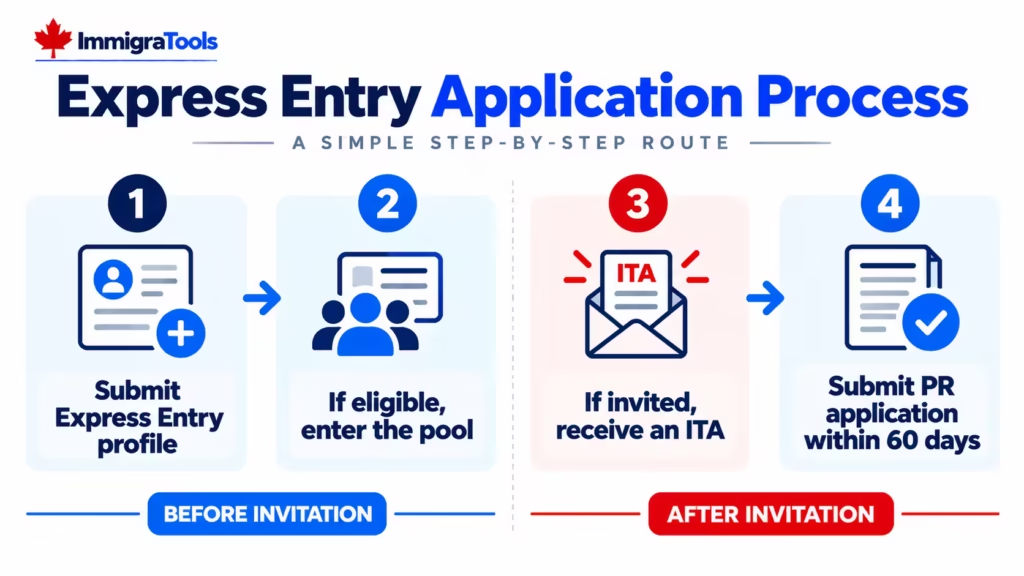
Where do you start? Open IRCC’s official Express Entry profile page and select “Sign in to your IRCC secure account.” You can create an account there if you do not have one.
- Under “Start an application,” choose “Apply to come to Canada.”
- If you have a personal reference code from IRCC’s Come to Canada tool, enter it when asked. Otherwise, choose “Express Entry” under “I do not have a Personal Reference Code” and answer the eligibility questions.
- Enter your valid language results, ECA details if needed, work history and other requested information. Review your answers and submit the profile.
If the profile is accepted, you enter the pool and receive a CRS score. Entering the pool is not a permanent residence application, and it does not guarantee an invitation. An uninvited profile expires after 12 months; you may create a new one after it expires if you still qualify. Source: IRCC application guidance.
Step 4: What happens in an Express Entry draw?
IRCC invites candidates from the pool through rounds of invitations. A round may be general, limited to a program, or based on a category such as specified language ability or work experience. You must meet the round’s requirements; a category is not a way around the underlying Express Entry program requirements. IRCC explains how rounds work and category-based selection.
The published CRS cut-off is the score of the lowest-ranked candidate invited in that particular round. It is a record of what happened, not a permanent minimum score for Express Entry.
Tie-breaking rule: when candidates share the cut-off score, IRCC uses the date and time their profiles were submitted to decide who receives the remaining invitations. That is one reason to enter the pool once you genuinely qualify and have the required valid results—rather than waiting for a hypothetical “perfect” score. See IRCC’s rounds page.
Make draw numbers meaningful: Compare your score with the latest Express Entry draw and the full draw history. Pay attention to the round type, not only its cut-off.
What can you do while waiting in the pool?
Keep your profile accurate. Update it when relevant circumstances change—for example, a new valid language result, work experience, family information, or a provincial nomination. Check your language test and ECA expiry dates while you wait. IRCC’s profile guidance explains why current information matters.
Improve what you can prove. Stronger approved language results can affect both direct language points and skill-transferability points. A nomination through an Express Entry-linked provincial stream adds 600 CRS points; a nomination through a separate, non-Express Entry stream does not automatically do that. See IRCC’s CRS criteria.
Step 5: You received an ITA. What must you do next?
An Invitation to Apply (ITA) is the point at which you can submit a full electronic application for permanent residence. Check the message in your IRCC account: it identifies the program you were invited under and gives the next steps.
Your deadline is 60 days. Start the online application promptly, upload the documents requested in your personalized checklist, pay the applicable fees and submit before the invitation expires. If you cannot substantiate a claim in your profile, resolve that before submitting rather than hoping it will be overlooked. Source: IRCC’s post-invitation instructions.
What should be on your post-invitation checklist?
- Work evidence: gather documents supporting the employment periods, duties and hours you claimed.
- Police certificates: check the rules for you and any applicable family members. Some certificates take time, so review IRCC’s country and timing requirements while you are in the pool.
- Medical exam: follow the current Express Entry medical instructions for when to complete it and which physician to use.
- Proof of funds: confirm whether your invited program requires it, count your family size correctly, and check IRCC’s current funds table immediately before applying.
- Every other requested item: use the document checklist generated for your application, including any family, identity or translation documents it asks for.
Proof-of-funds exemption is specific. IRCC says applicants invited under CEC do not need to show settlement funds. It also provides an exemption for someone authorized to work in Canada who has a valid job offer, even under FSWP or FSTP. Being physically in Canada by itself is not the test. IRCC’s system may still request a funds upload slot; its proof-of-funds page explains what to upload if you are exempt.
After you submit, IRCC may request biometrics or further information. If the application is approved, IRCC provides instructions for confirming your permanent residence. Time spent waiting in the pool varies, and processing after submission can vary too; avoid planning around a promised invitation or approval date. IRCC’s Express Entry process separates those stages.
Your first-week Express Entry checklist
- Identify your likely program. Check FSWP, CEC and FSTP requirements with the Eligibility Checker and IRCC.
- Match your actual work duties to a NOC. Use the NOC Finder to narrow the options.
- Choose an approved language test. Check which CLB or NCLC level your program requires in each skill.
- Request an ECA if needed. Use the Canadian equivalency in the report, not your own estimate.
- Calculate a realistic CRS score. Use your documented results in the CRS Score Calculator.
- Prepare for both outcomes. If invited, you will have 60 days to apply. If you wait in the pool, keep your details and documents current.
For more on programs, categories and draw data, see our Express Entry overview.