

Select text in this article, then choose Listen to start reading from there. Audio uses your browser’s text-to-speech voice.
Saved articles stay in this browser on this device.
Saved articles on this device
Clearing browser data removes this list.
Francophone immigration outside Quebec offers several routes to Canadian permanent residence. If you qualify for Express Entry and score at least NCLC 7 in all four French abilities, you may be eligible for French-language category draws and additional CRS points. Provincial and community pathways can also work, especially if you have a qualifying job offer. The best route depends on your language results, work experience, occupation, and where you genuinely intend to live.
Your starting point: Check three things before choosing a pathway: your score in each French-language ability, whether you qualify for an immigration program, and whether a province or community has a route that fits your circumstances.
What does Francophone immigration outside Quebec mean?
It means applying to settle permanently in a Canadian province or territory other than Quebec through a pathway that recognizes your French-language ability or fits your broader profile.
There is no single “Francophone immigration visa.” Your options may include French-language Express Entry selection, a provincial nomination, New Brunswick’s Francophone pathways, or the federal Francophone Community Immigration Pilot.
Start with your destination. If you intend to live in Quebec, the pathways discussed here are generally the wrong starting point. If you want to settle elsewhere, compare programs based on their actual requirements—not only on whether “French” appears in the name.
What French-language score do you need for Express Entry?
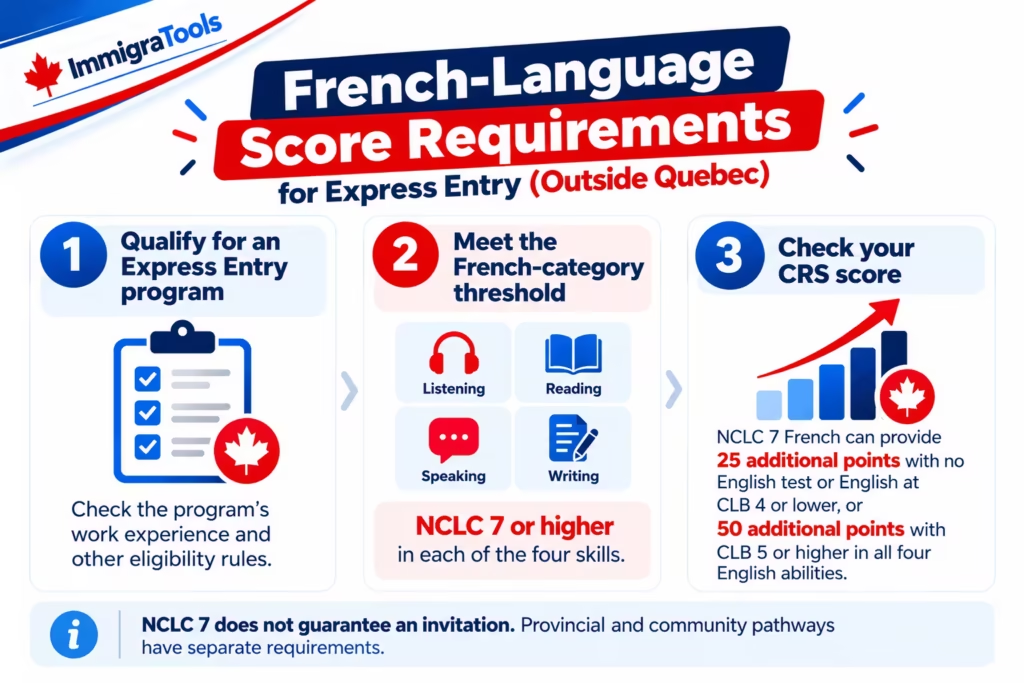
For Express Entry’s French-language category, you need at least NCLC 7 in speaking, listening, reading, and writing. NCLC stands for Niveaux de compétence linguistique canadiens, the benchmark used to describe French-language proficiency for Canadian immigration.
You must also qualify for an Express Entry program and meet the instructions for the particular invitation round. Reaching NCLC 7 does not automatically create an Express Entry profile or guarantee an invitation. Read IRCC’s category-based selection rules.
- NCLC 7 or higher in all four abilities: You meet the category’s French threshold, subject to the other rules.
- NCLC 7 in three abilities and NCLC 6 in one: You do not meet this threshold yet.
- NCLC 5 or 6 in all four abilities: Another immigration route may still fit, but not this Express Entry category.
Check each result separately. Express Entry accepts TEF Canada and TCF Canada for French. Language results must still be valid when you apply; check IRCC’s language-test instructions before booking a test or using older results.
Try it: Use the ImmigraTools Language CLB Converter to understand your results, then confirm them against IRCC’s official conversion tables.
Is NCLC 7 enough to qualify for Express Entry?
No. French-category eligibility and Express Entry program eligibility are separate checks.
You first need to qualify for at least one program managed through Express Entry: the Federal Skilled Worker Program, Canadian Experience Class, or Federal Skilled Trades Program. Each has its own work-experience, language, and other rules. Use IRCC’s Express Entry eligibility guide to confirm which fits you.
A strong French test does not replace qualifying work experience. Equally, someone who qualifies for an Express Entry program is not eligible for a French-category round unless all four French results meet NCLC 7.
Try it: Run the Express Entry Eligibility Checker before estimating your invitation chances.
How many CRS points can French give you in 2026?
If you have NCLC 7 or higher in all four French abilities, the Comprehensive Ranking System (CRS) offers additional French-language points:
- 25 additional points if your English results are CLB 4 or lower, or you have not taken an approved English test.
- 50 additional points if you also have CLB 5 or higher in all four English abilities.
French results may affect other parts of your CRS score too, depending on your profile and which language you list as your first official language. These 25 or 50 points are the specific additional French-language points, not necessarily your entire score increase. See IRCC’s CRS criteria.
A useful strategy: If your English is already at CLB 5 or higher in every ability, getting French to NCLC 7 across the board may unlock the 50-point bonus and French-category eligibility. Calculate your full score before choosing your first official language.
Try it: Compare scenarios with our French CRS Points Calculator and CRS Score Calculator.
Can a French-category draw invite you at a lower CRS score?
It can, but you should never assume that it will. IRCC ranks eligible candidates within each invitation round, and the cutoff changes with the number and strength of candidates invited.
Your NCLC 7 result does not “lower the cutoff.” It gives you access to French-category selection; your results may also raise your own CRS score. Compare actual rounds on our French-language draw page. A past cutoff cannot predict your next invitation.
What could NCLC 7 change for a real applicant?
Consider Maya, a fictional applicant who qualifies for the Federal Skilled Worker Program. Her approved English test shows CLB 5 or higher in all four abilities. Her first French test reaches NCLC 7 in speaking, listening, and reading—but NCLC 6 in writing.
At that point, Maya does not meet the French-category requirement or receive the additional French-language CRS bonus. She retakes an approved French test and reaches NCLC 7 in writing while maintaining at least NCLC 7 in the other three abilities.
Now two things change: Maya can be considered for French-category rounds, subject to the round’s instructions, and she qualifies for the 50 additional French-language CRS points because her English meets CLB 5 in all four abilities. Her complete CRS score may change in other ways, so she recalculates it rather than simply adding 50 to an old estimate.
This example shows why your lowest French ability often deserves the most attention. Moving one result from NCLC 6 to NCLC 7 can matter more than improving an ability that already exceeds the threshold.
Which provincial pathways should French-speaking applicants compare in 2026?
A provincial nominee program (PNP) can help when your work experience, job offer, or connections match a province’s priorities. French proficiency alone does not qualify you for every PNP, and provincial criteria can change during the year.
- New Brunswick: Examine its Strategic Initiative Francophone pathways and current selection priorities.
- Ontario: If you have a qualifying Ontario job offer, check the current Workforce Priority stream.
- Saskatchewan: Compare your Express Entry profile, occupation, and SINP points against current requirements.
- Atlantic provinces: Investigate the employer-driven Atlantic Immigration Program as well as relevant provincial routes.
Does New Brunswick have Francophone PNP pathways?
Yes. New Brunswick’s Strategic Initiative has used the Francophone Workers in New Brunswick and New Brunswick Francophone Priorities pathways in 2026 invitation rounds. These are provincial nomination options with selection criteria; an expression of interest is not an invitation or nomination. See New Brunswick’s invitation-round records.
If New Brunswick is a genuine settlement choice, review the province’s Francophone Priorities guide and the relevant pathway requirements. Pay particular attention to your French results, occupation, provincial ties, documents, and current invitation priorities.
Is Ontario’s French-Speaking Skilled Worker stream still open?
No. Ontario closed its former Express Entry French-Speaking Skilled Worker stream during its June 2026 OINP redesign. Advice telling you to submit a new application under that old stream is outdated. Ontario’s 2026 OINP updates confirm the closure.
Ontario’s Workforce Priority stream is now the route to investigate if you have a qualifying Ontario job offer; a separate pathway exists for eligible self-employed physicians. It is not a dedicated Francophone stream, so review the current Workforce Priority criteria instead of assuming French alone is enough.
Try it: Check your occupation with the NOC Finder, then compare it with Ontario’s official requirements.
Does Saskatchewan have a dedicated Francophone stream?
Saskatchewan’s SINP Saskatchewan Express Entry route may be relevant to a French-speaking applicant, but it is not a dedicated Francophone stream. You need an eligible federal Express Entry profile and must meet separate provincial criteria, including its points requirements. Review the official Saskatchewan Express Entry pathway before building your application strategy.
If Saskatchewan is your goal, examine occupation and provincial fit as closely as your language score. Strong French results do not remove the SINP’s other requirements.
What other Francophone-friendly routes exist outside Quebec?
Is the Francophone Community Immigration Pilot an option?
It may be if you want to settle in a participating community and can obtain an offer from a designated employer. The pilot requires at least NCLC 5 in all four French abilities, plus conditions such as qualifying work experience, education, settlement funds where required, and a community recommendation. It is a federal community pilot, not a PNP. Check IRCC’s pilot overview and eligibility rules.
This can change your strategy: NCLC 5 may be insufficient for French-category Express Entry yet meet this pilot’s language threshold. You still need the right job offer and every other requirement.
Can French speakers use the Atlantic Immigration Program?
Yes, if they meet its employer-driven requirements. The Atlantic Immigration Program (AIP) is open to eligible candidates with an offer from a designated employer in an Atlantic province. It is not reserved for French speakers and is not a PNP.
Its language minimum depends on the job’s TEER category: CLB/NCLC 5 for TEER 0–3 offers and CLB/NCLC 4 for TEER 4 offers. Language is only one part of the application, so review the complete program and provincial endorsement requirements. IRCC explains the AIP language thresholds.
How should you choose your best pathway?
- Confirm your four language benchmarks. Record speaking, listening, reading, and writing separately, and note when your results expire.
- Check federal eligibility. Find out whether you qualify for an Express Entry program before treating French-category draws as an option.
- Calculate current and potential CRS scores. Model French and English results, including whether another test could unlock the French-language bonus.
- Choose a realistic destination. For a provincial or community route, research where you would actually live and work.
- Match your occupation and job offer. Confirm your NOC code, employer requirements, licensing obligations, and provincial priorities.
- Verify rules again before applying. Invitation rounds, stream openings, and document instructions can change.
Quick decision guide: Have Express Entry eligibility and NCLC 7 in all four French abilities? Start with French-category selection and your CRS score. Have a qualifying job offer in a participating community or province? Compare that route alongside Express Entry. Have NCLC 5 or 6? Investigate pathways with different minimums while deciding whether a French retest is worthwhile.
Accuracy check: October 4, 2026. Immigration criteria and invitation priorities can change; verify the linked government guidance before applying.