
Select text in this article, then choose Listen to start reading from there. Audio uses your browser’s text-to-speech voice.
Saved articles stay in this browser on this device.
Saved articles on this device
Clearing browser data removes this list.
The Rural Community Immigration Program is a pathway to Canadian permanent residence for skilled workers who plan to settle in a participating community. You need a qualifying job offer from a designated local employer and a recommendation from that community before applying to Immigration, Refugees and Citizenship Canada (IRCC). The permanent program opens January 1, 2027; the current Rural Community Immigration Pilot closes that day.
If you are looking for a rural immigration route, the hardest part is often knowing where to start. This guide shows you how to check a community, match your occupation, assess the federal requirements and prepare a sensible application. IRCC’s program overview is the final authority on the rules.
What changed from the Rural Community Immigration Pilot?
The pilot and the permanent program have similar names, but they are not interchangeable applications. IRCC says the pilot closes on January 1, 2027, and the permanent Rural Community Immigration Program opens on that date. If you already have a pilot recommendation, follow the pilot instructions that apply to your certificate. If you are starting from scratch, follow the permanent program pages and check when your chosen community begins accepting applications.
Keep the three decision makers straight: a designated employer offers the job, a participating community decides whether to recommend you, and IRCC decides your permanent residence application. A job offer alone does not give you a community recommendation or PR.
Who can qualify for the Rural Community Immigration Program?
IRCC lists six main federal requirements: a valid community recommendation, a qualifying offer from a designated employer, related work experience, approved language results, a Canadian education credential or foreign equivalent, and settlement funds when required. You must also genuinely intend to live in the recommending community and meet the usual admissibility requirements. Check IRCC’s eligibility page before acting on any summary.
| Requirement | Quick check |
|---|---|
| Job offer | Qualifying offer from a designated employer in a participating community. |
| Community recommendation | The community must recommend you before you apply to IRCC. |
| Work experience | Usually 1,560 hours of related paid work in the past three years; some local graduates may be exempt. |
| Language | Approved English or French test; minimum CLB/NCLC 6, 5 or 4 in each skill, depending on the offered job’s TEER. |
| Education | Canadian high-school credential or a foreign equivalent, usually supported by an ECA. |
| Settlement funds | Amount depends on family size; an exemption may apply if you already work in Canada with a valid work permit. |
What kind of job offer do you need?
Your employer must be designated by the community, and the job must match that community’s priorities. Do not assume that every employer in a participating town qualifies. IRCC says communities will post their designated employers and available jobs on their own sites when ready. Start with IRCC’s community directory, then follow its link to the local site.
Check the occupation, not just the job title. A posting may call someone a “technician,” but your actual duties determine the National Occupational Classification (NOC) code. Use the ImmigraTools NOC Finder to narrow your options, then compare the duties with the official NOC description and the community’s current priority list.
What work experience counts?
Most applicants need at least one year, or 1,560 hours, of related paid work in the three years before applying. Full-time and equivalent part-time work can count, including qualifying work gained outside Canada. IRCC does not count volunteer work, unpaid internships or self-employment for this requirement. The experience must fit the NOC duties and an eligible TEER relationship to your offered job. See IRCC’s work-experience rules.
A graduate exception exists. Certain international graduates of publicly funded post-secondary schools in the recommending community can be exempt from the work-experience requirement. The program length, time spent studying in the community and date of graduation all matter. A degree alone does not automatically qualify you.
What language score do you need?
Your minimum English CLB or French NCLC level depends on the TEER category of the job offer, not your previous job. For TEER 0 or 1, you need level 6; for TEER 2 or 3, level 5; for TEER 4 or 5, level 4. You must meet the minimum in reading, writing, listening and speaking. Approved results must be less than two years old when you apply.
IRCC accepts CELPIP-General, IELTS General Training and PTE Core for English, and TEF Canada and TCF Canada for French. If test bands are confusing, use our language CLB converter as a quick check, then verify your result against IRCC’s conversion tables.
What education and money do you need?
You need at least a Canadian high-school credential or a foreign equivalent. A foreign credential normally needs an Educational Credential Assessment (ECA) from an approved organization. Settlement-fund requirements depend on family size and can change, so check IRCC’s current funds table instead of relying on a fixed amount in an article. IRCC says you do not need to show settlement funds if you are already working in Canada with a valid work permit.
Which communities participate, and how do you choose one?
IRCC’s current directory links to communities in Nova Scotia, Ontario, Manitoba, Saskatchewan, Alberta and British Columbia. The list and each community’s openings can change. Use IRCC’s live community links rather than an old screenshot or social-media list.
- Nova Scotia: Pictou County.
- Ontario: North Bay, Sudbury, Timmins, Sault Ste. Marie and Thunder Bay.
- Manitoba: Steinbach, Altona/Rhineland and Brandon.
- Saskatchewan: Moose Jaw.
- Alberta: Claresholm.
- British Columbia: West Kootenay, North Okanagan Shuswap and Peace Liard.
How should you narrow the list? Check a community’s current priority occupations and designated employers before spending time on an application.
- Start with your occupation: Check your real NOC code and duties.
- Check local priorities: Open a community’s official program site and find its current eligible sectors and occupations.
- Verify the employer: Look for the current designated-employer list and genuine vacancies. A business being in the region is not enough.
- Check timing: Read that community’s intake dates, recommendation process and any local scoring rules.
- Picture your life there: You are expected to intend to settle in the community, not use it as a paper address.
Not sure whether rural immigration is your best route? Our Canada Immigration Pathway Finder can help you compare broad options. It cannot confirm a community’s current employer designation or replace its local criteria.
How do you apply, step by step?
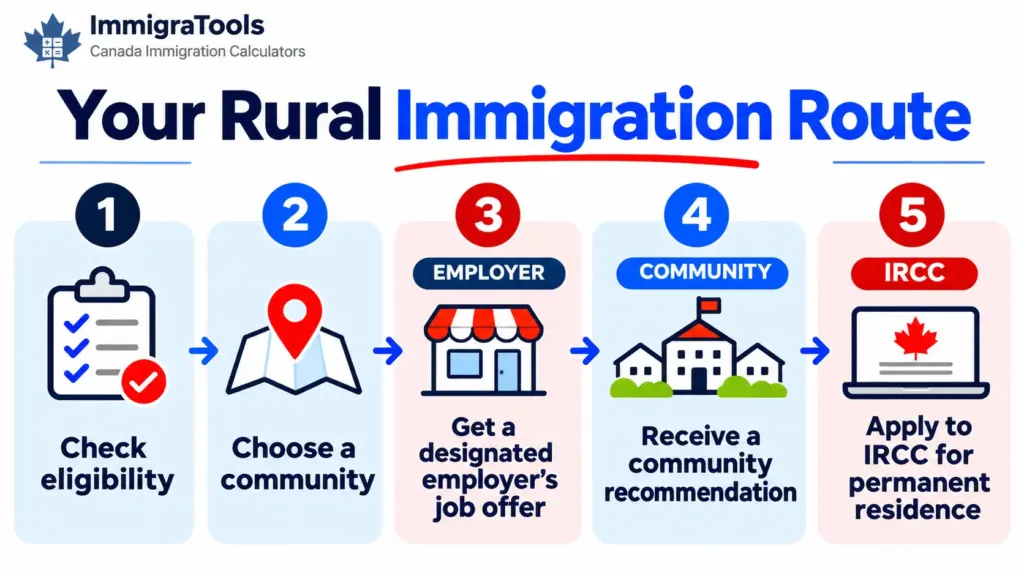
- Check the federal rules. Confirm your experience or graduate exemption, education, language level and funds.
- Choose a participating community. Read its official priority occupations, designated-employer list and intake instructions.
- Secure a qualifying job offer. Check the employer’s designation and make sure the job matches the community’s requirements.
- Get a community recommendation. Under IRCC’s process, the employer sends your recommendation application to the community. If approved, the community issues a certificate.
- Apply to IRCC for PR. Use the permanent program’s online application instructions, required forms and document checklist. A recommendation is a required step, not a guarantee of approval.
- Consider the optional work permit. If you qualify and want to work while IRCC processes PR, read the program-specific work-permit instructions.
Keep your work reference letters, language results, education documents, job offer and recommendation together. Your employer’s letter should accurately describe your duties, dates, hours and pay. IRCC’s PR application section lists the required documents and forms.
What does a realistic candidate check look like?
Imagine Maya has paid experience as a cook and finds a restaurant job in a participating community. She should not start by assuming that “cook” appears on every community’s priority list. First she checks her NOC duties, then the local site’s current occupation list, the restaurant’s designation and its job offer. After that, she checks whether her experience, language result, education and funds satisfy the federal rules.
If the restaurant is not designated or cooks are not a current local priority, her other qualifications do not fix that missing step. She can check another participating community or compare other routes with the Pathway Finder. This is an illustration, not an assessment of a real candidate.
Common mistakes to avoid
- Using an old pilot list: Community priorities and employer designations may change for the permanent program.
- Assuming this is Express Entry: This pathway has its own job offer and recommendation process; your CRS score is not the entry gate.
- Choosing a convenient NOC: Your actual main duties must support the code you claim.
- Booking the wrong language test: IELTS Academic, for example, is not on IRCC’s accepted-test list for this program.
- Applying to IRCC before the recommendation: The community certificate comes first.
Your next move: Pick one community, verify one occupation and one designated employer, then check your documents against IRCC’s federal requirements. That gives you a real path to investigate instead of a long list of towns that may have no suitable opening.
Rural Community Immigration Program FAQs
Reviewed November 20, 2026. The permanent program is scheduled to open January 1, 2027. Community priorities, intake windows and federal requirements can change; check the linked IRCC and community pages before applying.