
Select text in this article, then choose Listen to start reading from there. Audio uses your browser’s text-to-speech voice.
Saved articles stay in this browser on this device.
Saved articles on this device
Clearing browser data removes this list.
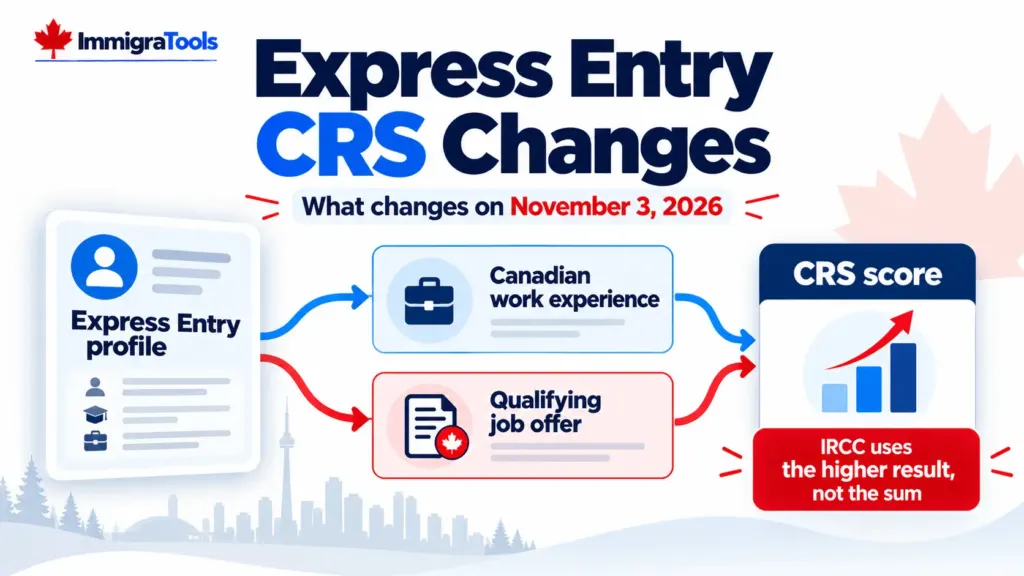
Express Entry changes 2026: New rules begin November 3. Canada will change how it awards CRS points for eligible Canadian work experience and qualifying job offers. Some experience in high-wage occupations may earn extra points, and an LMIA will no longer be required for a qualifying offer. You receive whichever of the two results is higher. The points do not add together. Your occupation and evidence matter more than your individual salary.
Already in the Express Entry pool? The useful question is whether your work history, NOC code and any job-offer details are accurate before the new calculation begins. Here is what changes, who may benefit and what to check now.
At a glance: The new Labour Market Integration factor can award up to 150 points without an accompanying spouse or partner, or 140 with one. Those figures include existing work-length points; they are not a bonus you add to today’s CRS total. Existing profiles will be recalculated automatically. Candidates seeking job-offer points need to review their profile information before November 3. Source: IRCC’s October 16 announcement.
What is changing in Express Entry on November 3?
IRCC is introducing a Labour Market Integration factor within the Comprehensive Ranking System (CRS). It compares two possible scores: one based on eligible Canadian work experience, including any high-wage occupation points, and another based on a qualifying job offer in a listed high-wage occupation. You get whichever score is higher. They do not stack.
| Route | What counts | Maximum |
|---|---|---|
| Canadian experience | Work-length points plus any qualifying high-wage experience points | 150 without an accompanying spouse or partner; 140 with one |
| Qualifying high-wage job offer | Points based on the occupation’s assigned wage level | 100 |
Canadian experience in an occupation outside the high-wage list can still earn work-length points. The official calculation page explains both routes and their limits.
How many new CRS points could high-wage work or a job offer earn?
IRCC places eligible NOC occupations into three wage levels. To receive the extra experience points, you need at least 12 months (1,560 hours) of qualifying Canadian work in one or more listed occupations. The level is based on the occupation’s national median wage, not what your employer pays you personally.
| Occupation wage level | Extra Canadian-experience points | Qualifying job-offer points |
|---|---|---|
| At least 2× the overall workforce median | 70 | 100 |
| At least 1.5×, below 2× | 40 | 70 |
| At least 1.3×, below 1.5× | 20 | 50 |
For experience, IRCC uses the highest threshold you satisfy. Qualifying time in different listed occupations may be combined, but overlapping jobs count only up to the equivalent of 30 hours a week. The experience points above are in addition to the points for the length of eligible Canadian work, but the entire experience result is compared with the offer result. Check IRCC’s full rules.
Which occupations qualify for the new high-wage points?
Start with the official high-wage occupation list, then confirm your National Occupational Classification (NOC) code against your actual duties. A high personal salary does not make an unlisted occupation eligible.
| Example NOC | Occupation | Listed wage level |
|---|---|---|
| 20012 | Computer and information systems managers | At least 2× |
| 21231 | Software engineers and designers | At least 1.5× |
| 11100 | Financial auditors and accountants | At least 1.3× |
These are examples, not the whole list. If you are unsure which code fits your work, use our NOC Finder as a starting point, then compare the suggested code with the official NOC description and your employment records. Do not choose a code because it awards more points if the duties do not match.
What could the change mean for your profile? Two examples
The following examples calculate only the new Labour Market Integration factor. They are not complete CRS scores. Both candidates are assessed without an accompanying spouse or partner, and we assume their experience and offers meet all requirements.
Example 1: Canadian experience wins
A software engineer has two years of eligible Canadian experience in NOC 21231 and a qualifying offer in that occupation. Two years of experience earns 53 work-length points; the high-wage experience adds 40, making the experience result 93. The offer would earn 70. IRCC would use 93, not 93 + 70.
Example 2: The offer wins
A candidate has one year of eligible Canadian experience outside the high-wage list and a qualifying offer as a computer and information systems manager. The experience result is 40; the offer result is 100. IRCC would use 100 for this factor. That is 60 more than the experience result, not an extra 100 on top of it.
Check your baseline: Our CRS Score Calculator can help you understand your current profile. Until its November rules are live and verified, do not treat it as a forecast of the new Labour Market Integration factor. Compare your circumstances directly with IRCC’s new points tables.
Will you still need an LMIA for Express Entry job-offer points?
From November 3, no LMIA will be required for a qualifying offer to count for the new CRS job-offer points. An LMIA also will not give extra CRS points or priority by itself. The offer must still be valid and genuine, generally for full-time, continuous work in Canada for at least one year after permanent residence; some occupations have specific rules.
An IRCC officer will assess the employer’s ability to fulfil the offer, whether the role meets a real business need, and whether you are qualified and likely to take the job. An open work permit alone is not a qualifying offer. See IRCC’s job-offer requirements.
A job offer can also matter for program eligibility without earning high-wage CRS points. For example, an eligible offer may help under the Federal Skilled Worker or Federal Skilled Trades programs even when it earns no high-wage CRS points. Each program has its own job-offer rules, so keep program eligibility and CRS points separate.
What should you check in your Express Entry profile before November 3?
IRCC says existing pool profiles will be recalculated automatically after the rule change, a process that could take up to two weeks. Invitation rounds will pause during recalculation. But if you want job-offer points, review and update the required offer information before November 3. Read IRCC’s announcement.
- Check your NOC: Does the occupation description match your real day-to-day duties and supporting documents?
- Check Canadian work dates and hours: Build a clear timeline, especially if you changed employers or worked concurrent jobs.
- Check the written offer: Are the employer, role, work location and terms accurately recorded in your profile?
- Check your evidence: Can you document the experience or offer on which the new points depend?
- Check basic eligibility separately: A higher CRS score does not replace the requirements of an Express Entry program. Use our Express Entry Eligibility Checker to review the program gates.
What about the temporary LMIA fields in the IRCC portal?
IRCC has published a transitional workaround starting November 3, 2026 because the online profile fields will not immediately match the new LMIA rules. For the specific job-offer-without-an-LMIA situation described by IRCC, its instructions say to select “Yes” for a positive LMIA and enter 00000 as the LMIA number, with issuance date 2026-01-01 and expiry date 2029-01-01.
Do not use those entries before November 3 or for every job offer. Reopen IRCC’s current instructions when you update your profile; transitional portal guidance can change.
Does a higher score guarantee an invitation?
No. You still have to qualify for an Express Entry program, and invitations depend on the type of round, its criteria and its CRS cut-off. Look at our latest Express Entry draw for recent context, but do not mistake an old cut-off for a prediction of the next one.
What to do now: Confirm your program eligibility, match your real duties to the correct NOC, review your work history and any offer, and save supporting documents. Then check your recalculated CRS score after IRCC applies the change. A careful profile is more valuable than guessing how many points your occupation might receive.
Frequently asked questions
Updated October 18, 2026. This guide summarizes announced rules scheduled for November 3. IRCC’s official pages control if requirements or portal instructions change.