
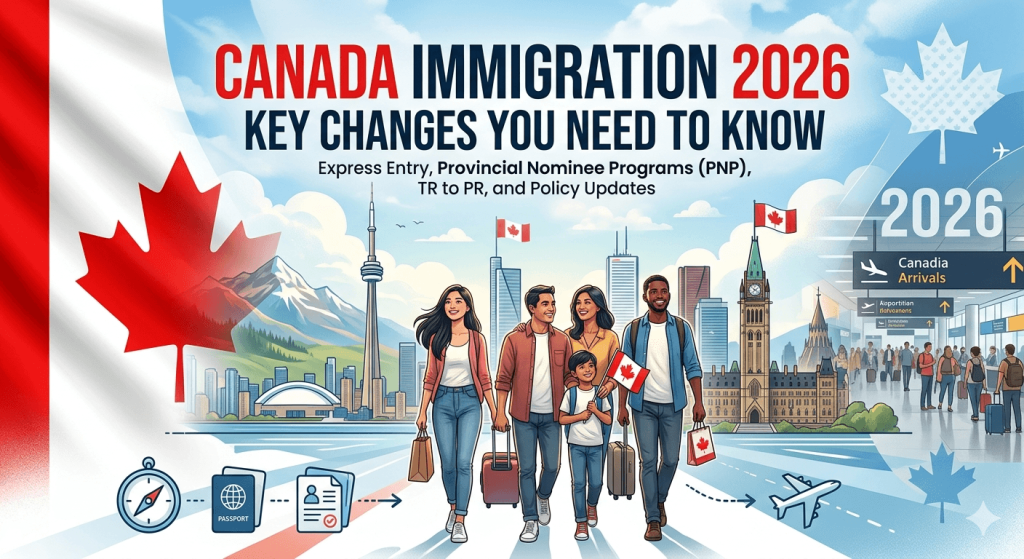
Canada immigration in 2026 looks different from the post-2020 surge years. Federal draws are more targeted, provinces are competing for skilled workers in specific sectors, and IRCC continues to tighten alignment between NOC codes, language results, and program eligibility. If you are planning a move, the winners are not the ones who read the most headlines — they are the ones who adapt their profile to how selection actually works now.
This overview explains the biggest 2026 immigration shifts affecting skilled workers: Express Entry categories, PNP trends, occupation classification, and practical steps you can take this month using our free immigration tools.
Disclaimer: Policy evolves. Treat this as a planning guide and verify critical decisions on official IRCC and provincial websites.
Express Entry category-based draws are now standard
Since 2023, IRCC has run category-based selection alongside general draws. In 2026, targeted rounds remain central to federal strategy. Categories have included:
- French-language proficiency
- Healthcare occupations
- STEM occupations
- Skilled trades
- Transport
- Agriculture and agri-food
These draws often have lower CRS cut-offs than all-program rounds — sometimes dramatically. Track real numbers on our Express Entry Draw History page and compare your score with the CRS Calculator.
What category-based selection means for your CRS strategy
You might not need 490+ CRS if you qualify for a targeted round — but you must:
- Be in the Express Entry pool with an eligible program (check eligibility)
- Have a qualifying NOC occupation or French scores — verify with the NOC Finder
- Maintain valid language results (two-year expiry)
Read our detailed playbook: How to Improve Your CRS Score in 2026.
Immigration levels and federal priorities in 2026
Ottawa has recalibrated multi-year levels plans amid housing and infrastructure pressures. Skilled economic immigrants remain central, but there is greater emphasis on:
- Occupations with demonstrable labour shortages
- Francophone immigration outside Quebec
- Candidates already working in Canada (CEC pathways)
- Integrity and document accuracy in applications
That does not mean doors are closed — it means generic profiles face more competition than targeted ones.
NOC 2021 and TEER: why your job title is not enough
IRCC uses NOC 2021 with TEER categories. In 2026, misclassified occupations remain a top reason candidates miss category draws or PNP streams. Your duties must match the official lead statement — not just your LinkedIn title.
Workflow:
- Search titles with the NOC Finder
- Confirm TEER 0–3 for most skilled federal pathways
- Reuse the same NOC consistently in EE, OINP, and BC PNP files
Provincial Nominee Programs in 2026
PNPs are increasingly important when general CRS cut-offs are high. Provincial highlights skilled workers should watch:
Ontario (OINP)
Large nomination allocation; mix of Express Entry Human Capital Priorities and employer EOI streams. Estimate points with the OINP Calculator — read every OINP stream explained.
British Columbia (BC PNP)
SIRS scoring with frequent priority-sector draws (tech, healthcare, childcare, construction). Model your 200-point grid with the BC PNP Calculator — see our BC PNP Skills Immigration guide.
Other provinces
Alberta, Saskatchewan, Manitoba, and Atlantic programs continue to target regional labour needs. Compare pathways with the PNP Score Calculator before you fixate on one province.
Express Entry vs PNP in 2026: still both
The federal vs provincial question has not gone away. Enhanced nominations still add 600 CRS points. Most competitive applicants pursue federal pool entry and provincial registrations. Full comparison: Express Entry vs PNP.
Language tests: IELTS, CELPIP, and French
Language remains the fastest lever many candidates control. English test choice (IELTS vs CELPIP) should be strategic — see our IELTS vs CELPIP for CRS guide. Strong French can unlock both CRS bonuses and dedicated draws — map any test to CLB via the CLB Converter.
What you should do this month
- Confirm Express Entry eligibility (FSW / CEC / FST)
- Verify your NOC and TEER
- Convert language scores to CLB
- Calculate CRS and compare to recent draws
- Screen provincial pathways if federal cut-offs are above your score
- Build a 6–12 month improvement plan (language, experience, or nomination)
Free tools on Immigration Tools
Every calculator on this site is designed around published IRCC and provincial criteria — updated for 2026 planning:
- CRS Score Calculator
- Express Entry Eligibility Checker
- Express Entry Draw History
- NOC Finder
- CLB Converter
- PNP Score Calculator
- OINP Points Calculator
- BC PNP Points Calculator
Canada immigration in 2026 rewards preparation and precision — not optimism alone. Track policy shifts, but spend most of your energy on the factors you can change: language, NOC accuracy, provincial fit, and a CRS score you can defend with evidence.