

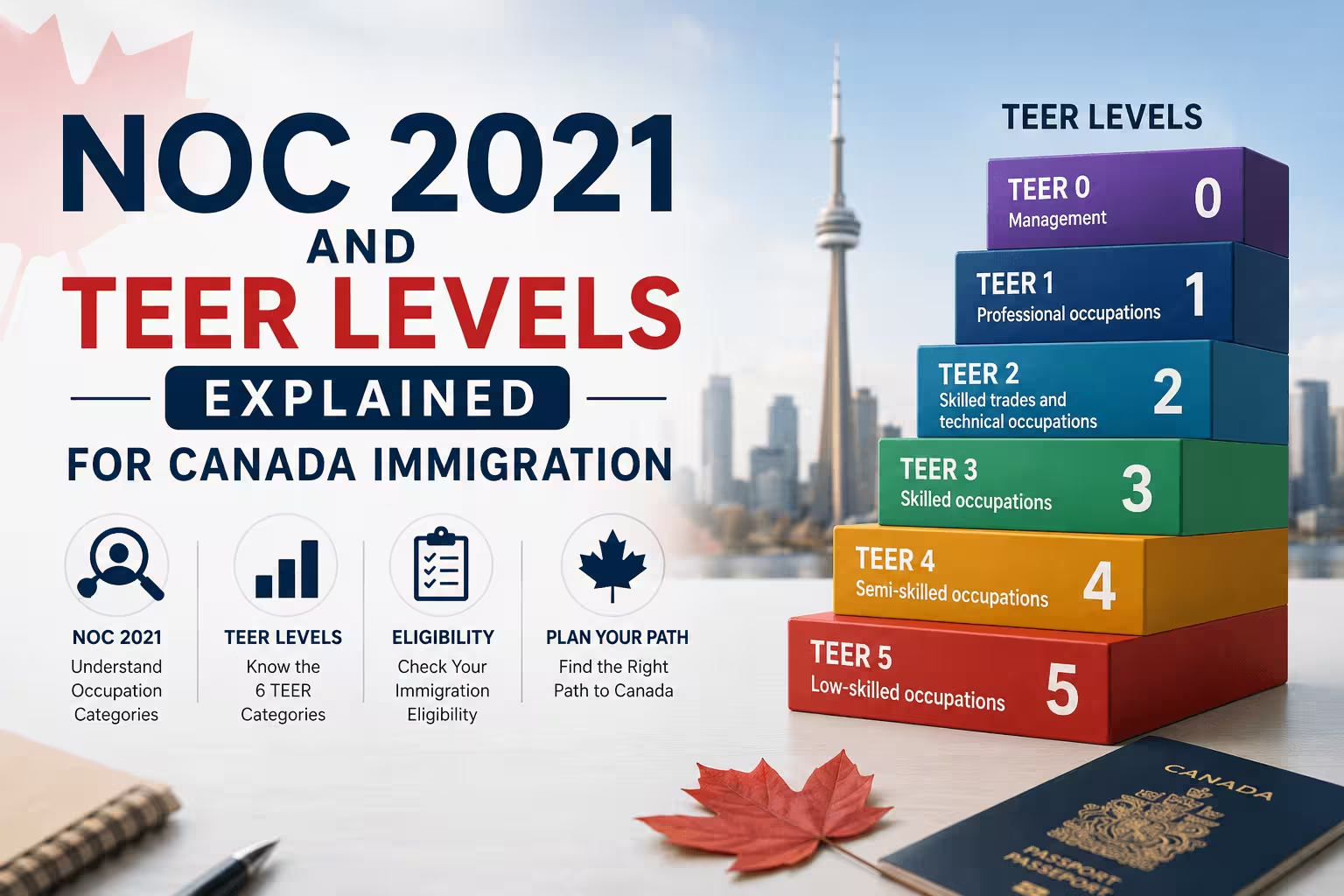
If you have ever searched for your occupation on IRCC forms and felt lost between similar job titles, you are dealing with NOC 2021 TEER levels and getting them wrong can quietly disqualify you from Express Entry, a Provincial Nominee Program (PNP), or a category-based draw before you even calculate points.
Canada no longer uses NOC 2016 skill types (A/B/C/D). Since late 2022, immigration programs reference NOC 2021 and classify jobs by TEER (Training, Education, Experience and Responsibilities) levels 0 through 5. Your code must match the work you actually perform — not just your employer’s HR title.
This NOC TEER guide explains how the system works in 2026, which TEER levels matter for skilled immigration, how to pick the right five-digit unit group, and where to verify your choice before you submit a profile. Start with our free NOC Finder as you read.
What is NOC 2021?
The National Occupational Classification (NOC) is Canada’s official system for describing occupations. Immigration officers, employers, and provincial programs use it to decide whether your work experience counts as “skilled,” whether you fit a stream, and whether you qualify for targeted Express Entry draws.
NOC 2021 replaced the older 2016 edition for most federal and provincial programs. Key differences:
- Jobs are grouped into unit groups identified by a five-digit NOC code (e.g. 21231 for software engineers)
- Each unit group sits at a TEER level (0–5) instead of the old Skill Type A/B/C/D labels
- Broader occupation titles (NOC 2021 “broad categories”) contain many specific unit groups — you must pick the unit group that matches your duties
IRCC generally expects your claimed NOC to reflect 12 months of continuous skilled work (or the program minimum) in that occupation, supported by reference letters that describe duties aligned with the NOC lead statement.
TEER levels explained (0–5)
TEER ranks how much training, education, experience, and responsibility a role typically requires. For most skilled economic immigration pathways, TEER 0, 1, 2, and 3 are relevant; TEER 4 and 5 are usually excluded from Express Entry skilled worker routes (with limited exceptions in specific PNP streams).
| TEER | Typical education / training | Examples | Express Entry (FSW/CEC) |
|---|---|---|---|
| 0 | Management experience; often degree + experience | Restaurant manager, IT manager, construction manager | Eligible (skilled) |
| 1 | University degree (bachelor’s or higher) | Software engineer, accountant, registered nurse | Eligible (skilled) |
| 2 | College diploma or apprenticeship (2+ years) | Computer network technician, medical lab technologist | Eligible (skilled) |
| 3 | College, apprenticeship, or several years of experience | Administrative officer, baker, plumber | Eligible (skilled) |
| 4 | Short work training or secondary school | Retail supervisor, home child care provider (some streams) | Usually not EE skilled worker |
| 5 | Short demonstration or no formal training | Food counter attendant, labourer | Usually not EE skilled worker |
Confirm eligibility gates with the Express Entry Eligibility Checker — NOC/TEER is only one part of the puzzle.
Why your NOC code matters for CRS and draws
Your NOC unit group affects immigration in ways that are easy to miss:
- Program eligibility — FSW and CEC require skilled TEER 0–3 work (with CEC rules tied to Canadian experience)
- Category-based Express Entry draws — healthcare, STEM, trades, transport, agriculture, and French-targeted rounds filter by eligible NOC lists
- Provincial streams — OINP, BC PNP, and others prioritize specific occupations or TEER bands
- Job offer points — a valid offer must usually align with a skilled NOC for CRS or PNP credit
A strong CRS score does not help if your occupation is miscoded or not skilled. Track current cut-offs with Express Entry draw results and read Canada immigration 2026 key changes for how category draws evolved.
NOC 2016 vs NOC 2021: what changed for applicants
| Topic | NOC 2016 | NOC 2021 |
|---|---|---|
| Code format | Four digits (e.g. 2173) | Five digits — unit group (e.g. 21231) |
| Classification | Skill Type A/B/C/D | TEER 0–5 |
| IRCC usage | Legacy references only | Current standard for new applications |
| Job titles | One code per broad title | More granular unit groups; duties decide the match |
If an old forum post cites NOC 2016 codes, convert using official concordance tables or search by duties in the NOC Finder — do not assume a one-to-one swap.
How to choose the correct NOC unit group
Follow this practical workflow before you lock a code in your Express Entry profile or provincial registration:
- List your actual duties — daily tasks, tools, supervision, outputs (not just your business card title)
- Search by duty keywords in the NOC Finder — try multiple phrases (“develop software,” “API,” “database”)
- Read the lead statement and main duties for each candidate unit group on the official NOC page
- Compare TEER level — ensure the group is TEER 0–3 if you need skilled EE experience
- Match reference letters — ask employers to describe duties using NOC-aligned language
- Keep evidence — pay stubs, contracts, and org charts support your choice if questioned
Common NOC selection mistakes
- Picking the highest-paying or most prestigious title instead of the job you actually do
- Using a manager code (TEER 0) when you have no genuine management duties
- Ignoring TEER — assuming all “professional” titles are TEER 1
- Choosing a category-draw NOC without verifying you meet that category’s full criteria
- Mixing part-time unrelated jobs to fabricate one year in a code that does not fit
NOC and Provincial Nominee Programs
Provinces do not replace NOC — they layer priorities on top of it. Examples:
- OINP EOI factors include NOC broad category and in-demand lists — estimate points with the OINP Calculator
- BC PNP SIRS requires eligible TEER 0–3 occupations for most skilled streams — model scores with the BC PNP Calculator
- Other provinces use targeted occupation lists that change with labour market needs
Compare federal vs provincial strategy in our Express Entry vs PNP guide and explore regional options via the PNP Score Calculator.
NOC, language (CLB), and CRS together
NOC proves what work you did; language scores prove how IRCC ranks you in the pool. Skill transferability points combine education, foreign work, and CLB thresholds — so a correct NOC plus stronger language can compound gains on the CRS Calculator.
Map IELTS or CELPIP results to CLB with the Language CLB Converter. If language is your main lever, see How to Improve Your CRS Score in 2026.
Using the NOC Finder on Immigration Tools
Our NOC Finder searches thousands of occupation titles against official NOC 2021 unit groups and codes. Use it to:
- Search by job title or five-digit code
- See TEER level and broad category at a glance
- Jump to related tools (CRS, eligibility, PNP) from one place
The finder is a research aid — your final NOC must still match documented duties and current IRCC program requirements.
Checklist before you submit your profile
- Selected a five-digit NOC 2021 unit group (not NOC 2016)
- Confirmed TEER 0–3 for skilled Express Entry experience (if applicable)
- Reference letters describe duties aligned with the NOC lead statement
- Checked category-based draw lists if you rely on targeted rounds
- Verified provincial occupation rules if pursuing PNP
- Re-ran the CRS Calculator and Eligibility Checker with the final code in mind
Next steps
Immigration success is rarely one form field — it is a stack of aligned choices. Lock your NOC TEER match first, then optimize language, CRS, and provincial pathways with the free tools on Immigration Tools. When policy shifts, start with Canada immigration 2026 key changes and stay close to official IRCC updates.